



11 Wonderful Things to Do in Folegandros, Greece
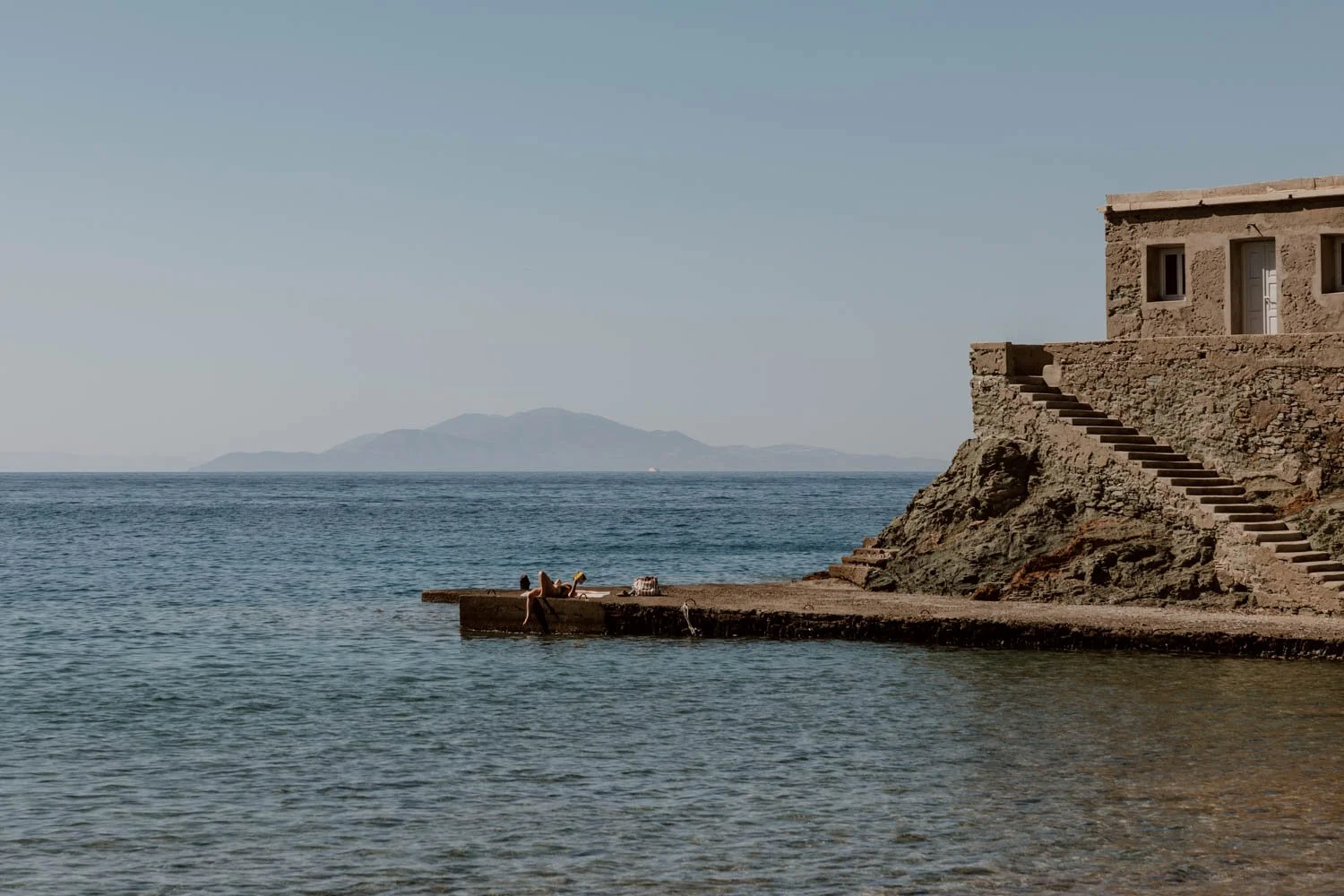
The worry started when the young receptionist in Perissa told us 'everyone is going to Folegandros'.
We weren’t certain if her tone leaned more toward surprise than concern, but it was the latter which we carried on our winding ride down the hill to the hot, chaotic port.
Without sounding too smug about it, we’d absolutely aced our choice of Greek islands the previous summer, and little Folegandros felt like another banker. Sure, its proximity to Santorini may make it a bit more crowded and popular with day-trippers, but it still didn’t seem to be on the mass-market radar and barely ever appeared in our social media feed.
But, these days, things can shift so quickly, and somewhere can ‘pop’ in the space of a few weeks.
Maybe, we thought, it was our radar that was squiffy or we’d just missed the memo that Folegandros was ‘hot’ right now.
Thankfully, if this cruiseship-free island was having a moment, it was more a whisper than a shout.
-
High-sided and rugged, with single road running along its spine, little Folegandros remained exactly as we’d hoped. Its best beaches were secrets to be found at the end of a scramble, a stumble, or a seat-clinging descent down a dusty road; the days were long and languid; the crushed velvet sea and call of cicadas a constant companion; and the balance between the old and the new felt just about right. The lilt of Greek and Italian were more common than English or German.
In a line? We’d call the vibe mostly understated and elegant, but without having lost the rustic and rugged soul which makes Folegandros so appealing in the first place.
The beauty is that, for the traveller, you can choose to straddle those two complementary - rather than conflicting - elements as much as you wish. By evening, those in white linen who slipped ashore just before dusk share the same tables and drink the same honey raki as those who still have dust, sand, and sunburn between their toes.
By then, the glow and quiet satisfaction of a day well spent on this sun-bleached rock belongs to everyone.
In this guide, we’re going to share our favourite things to do in Folegandros (including the best beaches and swimming spots) as well as our advice on where to stay, how to get around, and a few excellent places to eat/drink. Whether your stop is only for a few days on a Greek island-hopping adventure, a standalone summer holiday choice, or you’re simply going to be moored off the island for a few days, we’ll help you find your somewhere.
This is our travel guide to Folegandros, Greece.
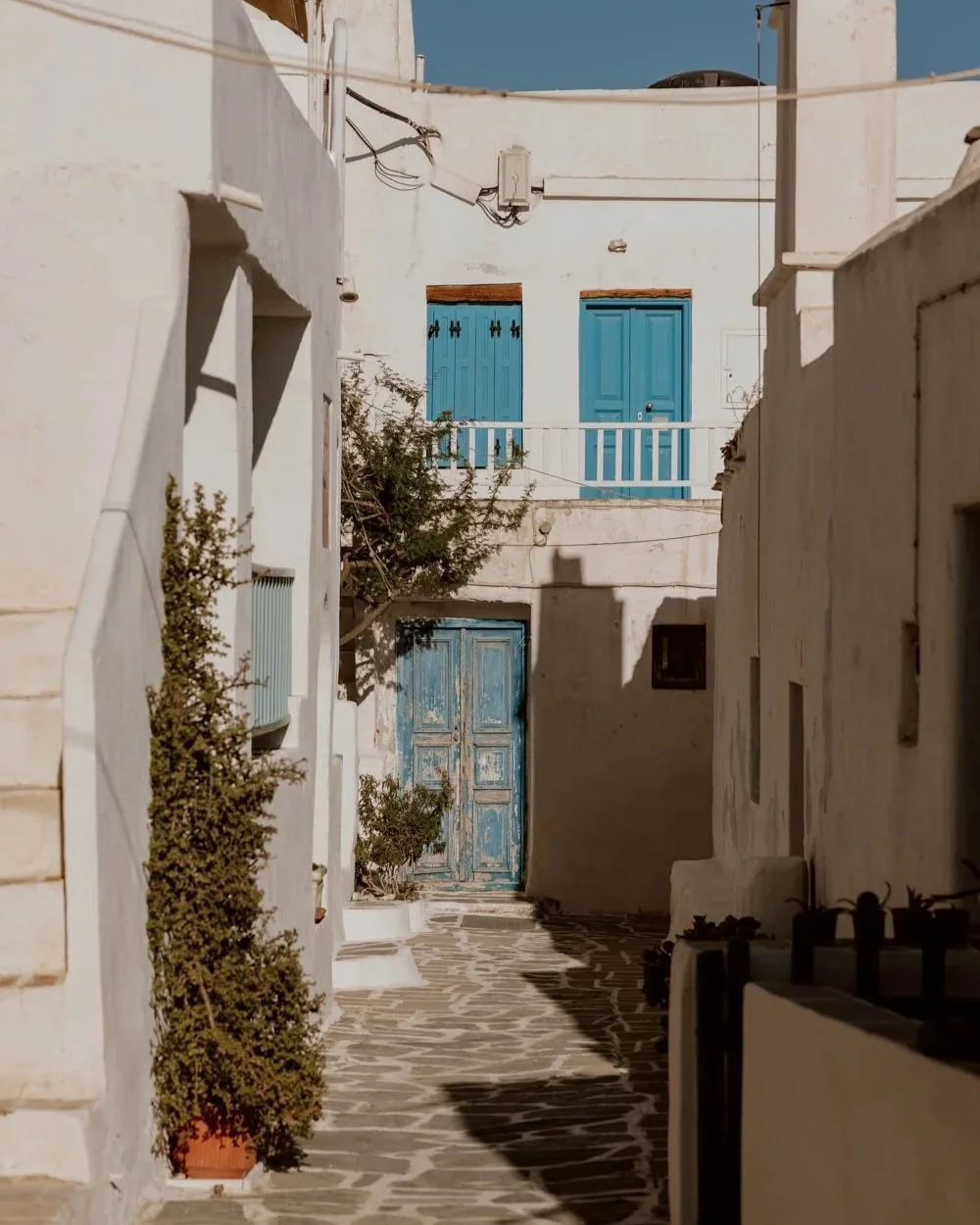
The Folegandros Essentials
Arrive / By ferry from Athens or nearby islands
Hike / Down to secluded beaches like Livadaki and Katergo
Do / A boat tour to hidden coves and secret beaches
Drink / Honey raki at Astarti Bar
Eat / A farm to table dinner at La Spina
Rent / An ATV or scooter to get around the island
Laze / On the sand at Paralia Agali
Enjoy / Sunset from the Church of Panagia
Book / The local-led tour that focuses on the island’s history and culture
Stay / For hotels, splurge at Gundari, opt for something more central like Avaton, or be by the beach at Blue Sand Boutique Hotel
Lots of gorgeous Airbnbs but don’t miss Cliffhouse, the apartment we stayed in, Perigiali Family Apartment, Maistros or Themonia to Taximi
The Best Things To Do in Folegandros, Greece
A Day at Paralia Katergo
Katergos is symptomatic of the sort of beach - and beach day - one should expect to have in Folegandros.
Tucked in at the base of cragged cliffs, there's nothing there expcept the coarse sand, the stones and the endless blue, and unless you take the late-to-start taxi boat, the bay is only accessible via a dusty trail that passes through toasted earth and the remains of an abandoned village.
The descent is as dramatic as it is steep, and one has to bring in everything (and bring it all back out).
Nudity isn’t uncommon.
So far, so Folegandros - and it’s perfect.
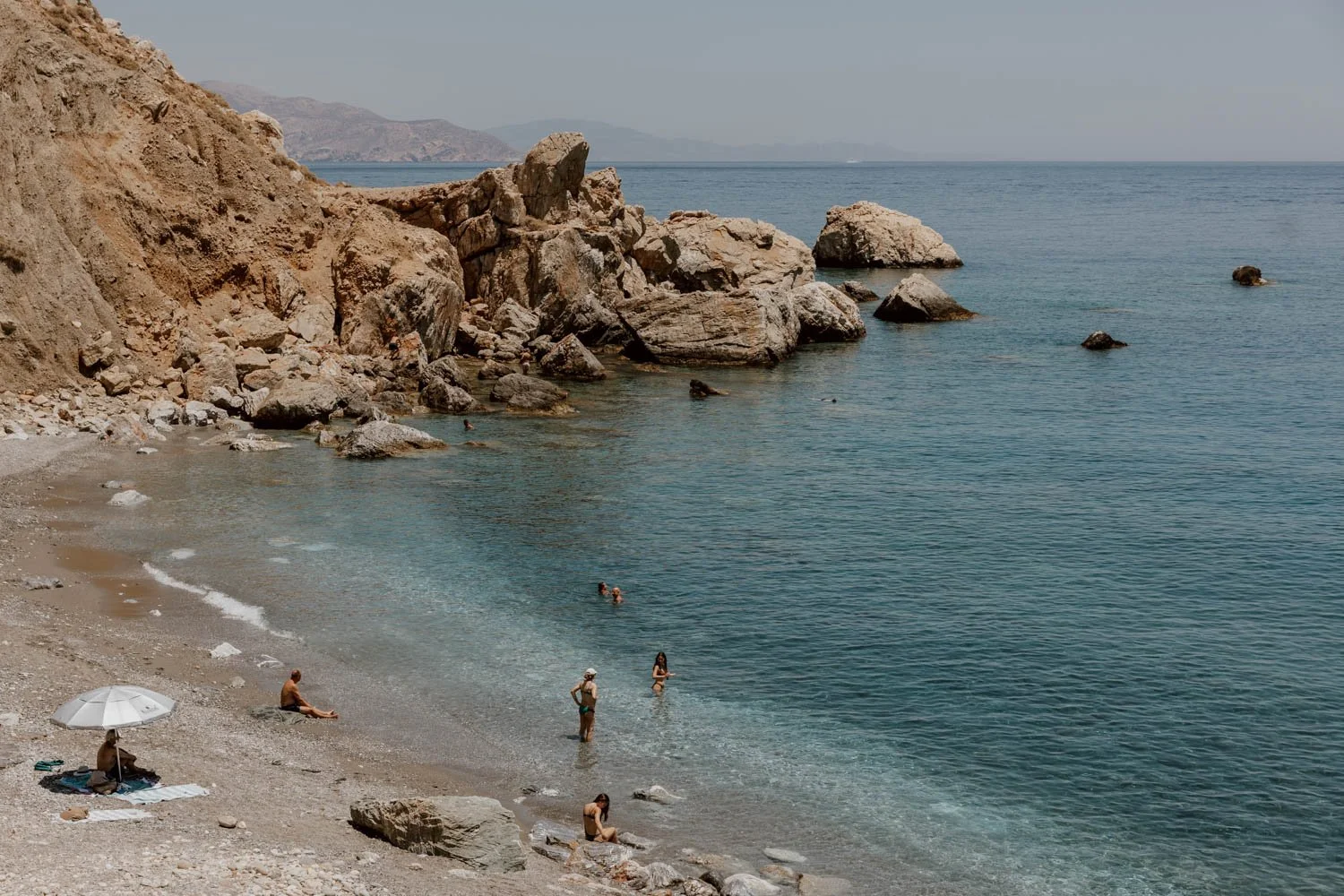
Where | You can find Paralia Katergo here on Google Maps, but it’s not a place for which you can spontaneously set out. Instead, you have to rent your own wheels or take one of the taxi boats.
Drive & Walk | It’s fun 10-minute drive from Karavostasis to the small dusty parking area after the turnoff (here on Google Maps). This is a rural part of the island, and the single-track mostly flat road is suitable for scooters. From the parking lot, it's a 20-30 minute walk along the flat dusty trail, then the steep, rough descent down to the beach. Shoes or sandals are going to much better than flip-flops. The walk will be manageable for most, but note there is little shade along the way.
If you set off early enough, it's a totally feasible and enjoyable to walk to Paralia Katergo from Karavostasis. Emily did this one day, taking about 40 minutes to reach the car park, but you should only attempt it if you set off early enough and bring plenty water.
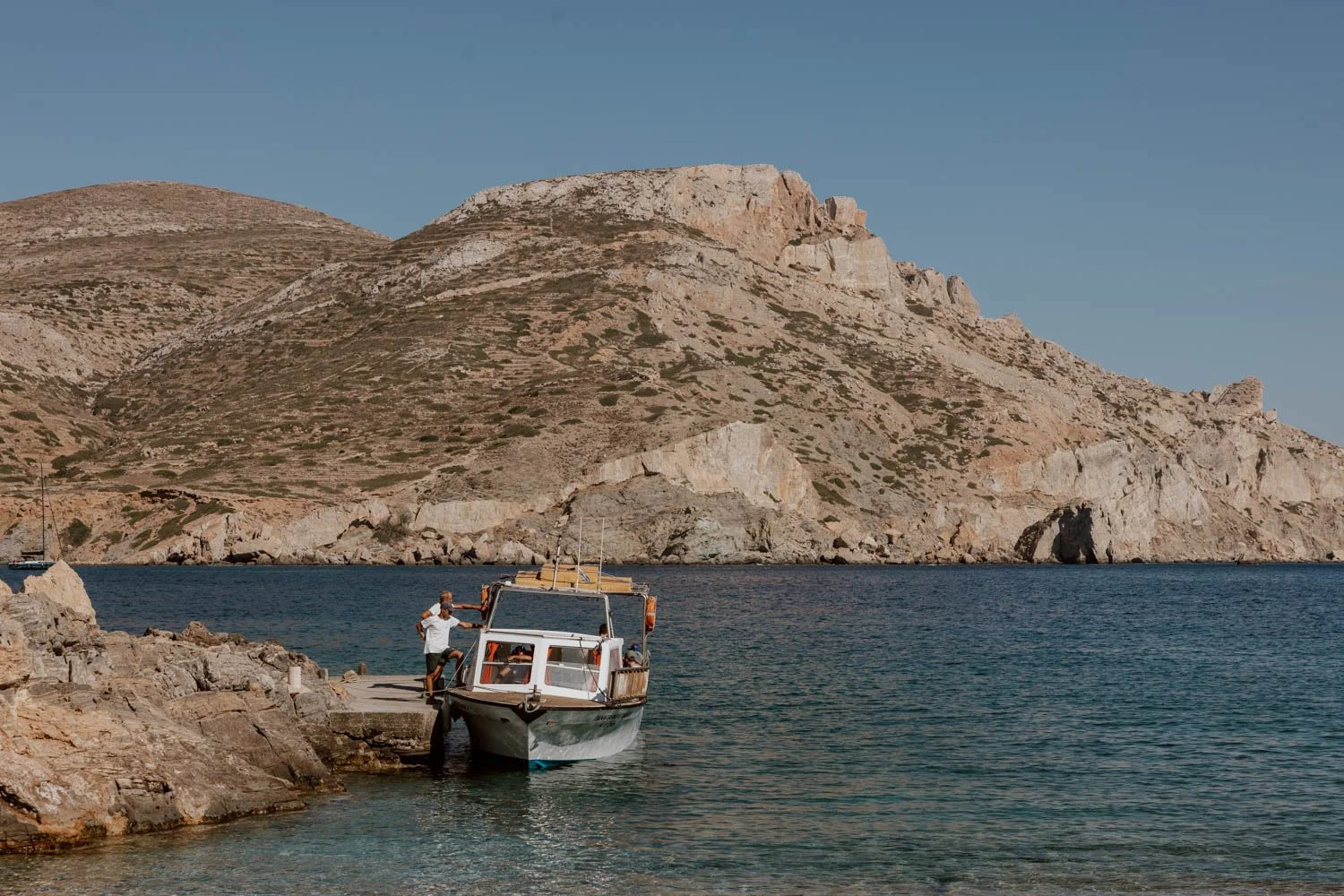
Boats | Katergo is one of three Folegandros beaches served by taxi boat. The Stella Express III departs daily from Karavostasis - the port village where the ferry arrives - and the first departure is at 11.15am (a very Greek schedule), then usually on the hour thereafter. It takes just 10-minutes to reach the beach with a photo stop at Giorgitsis Cave, and a round-trip ticket is €14 per person. Tickets are purchased on board (cash). Note you’ll get likely get wet when disembarking.
The first boat back to the port is 11.30am, and then at 12.15pm, 1.15pm etc. If you’re planning on taking on of the last two boats back, note that there may be a nearly two-hour gap between them (3.15pm - 5pm - 6.30pm on the 2025 schedule).
Our advice? Take a photo on arrival of all the current boat and bus schedules you’ll see stuck up around the port and in the Chora - it’s incredibly useful to have these at hand whilst you’re on the island.
Know | The taxi boat obviously brings and deposits many more people on Katergo beach than would usually come via the trail. This increased accessibility does have its downsides for those seeking out pristine, rustic isolation, but it isn’t terminal. If you’re making your way by foot or your own wheels simply take advantage of the boat's late morning start and begin your day earlier; this will give you a guaranteed couple of hours with barely anybody else there (and allow you to nab the best spot).
The taxi boat deposits everyone on the right side of the beach (as you face the sea), so that always becomes busier. The left hand side is more isolated, dispersed, and nudist-friendly.
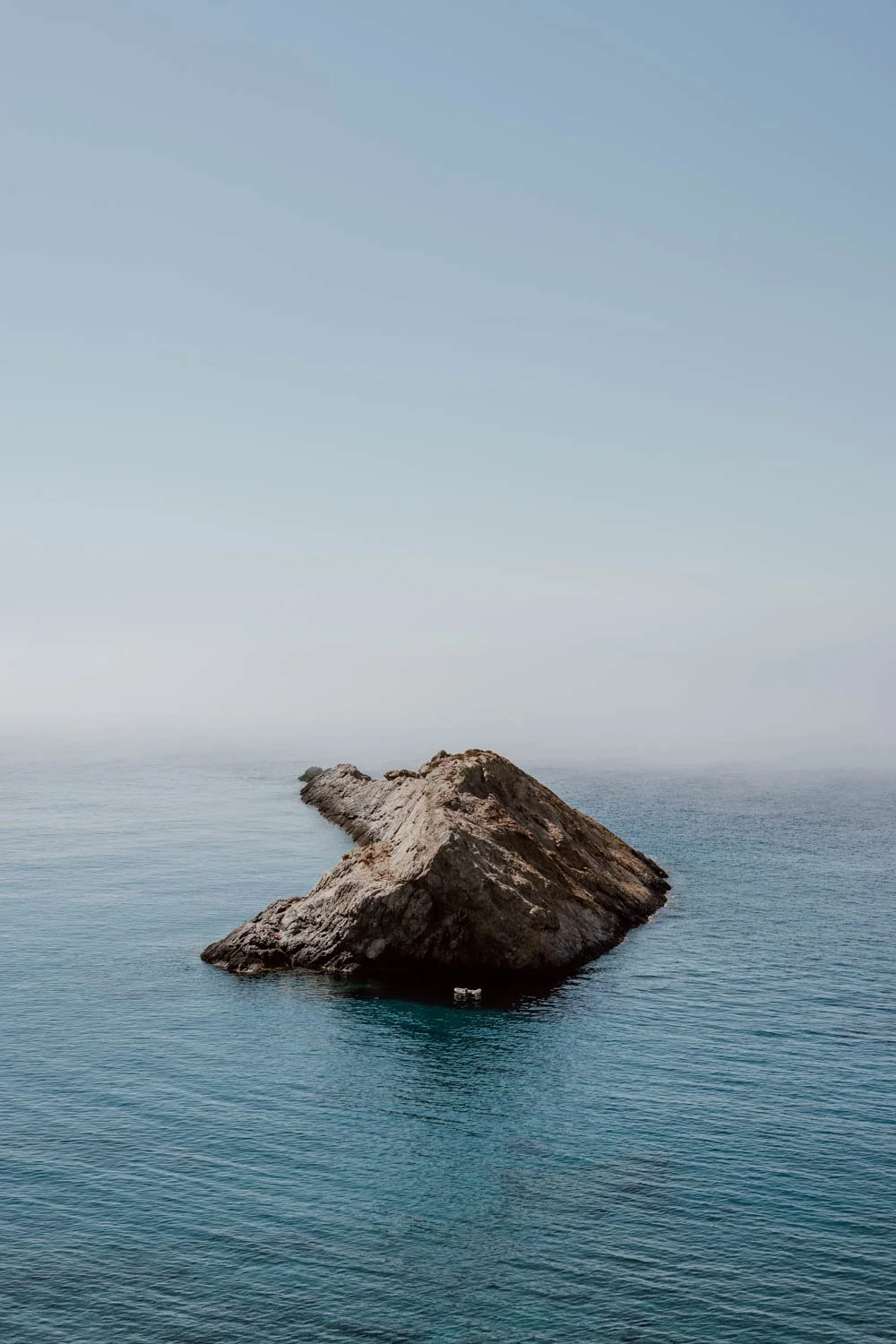
Bring | However you arrive, you need to take everything you’ll need - and more water than you think. There’s little to no shade on the beach, so a parasol is essential for anyone hoping to spend more than a few hours. Also, know that you can swim over to the rocky island!
Travel Tip // On the drive or walk to Paralia Katergo, you'll pass Paralia Livadi (maps). It's one of the most accessible beaches on the island with a vehicle, but the one we rated lowest on Folegandros.
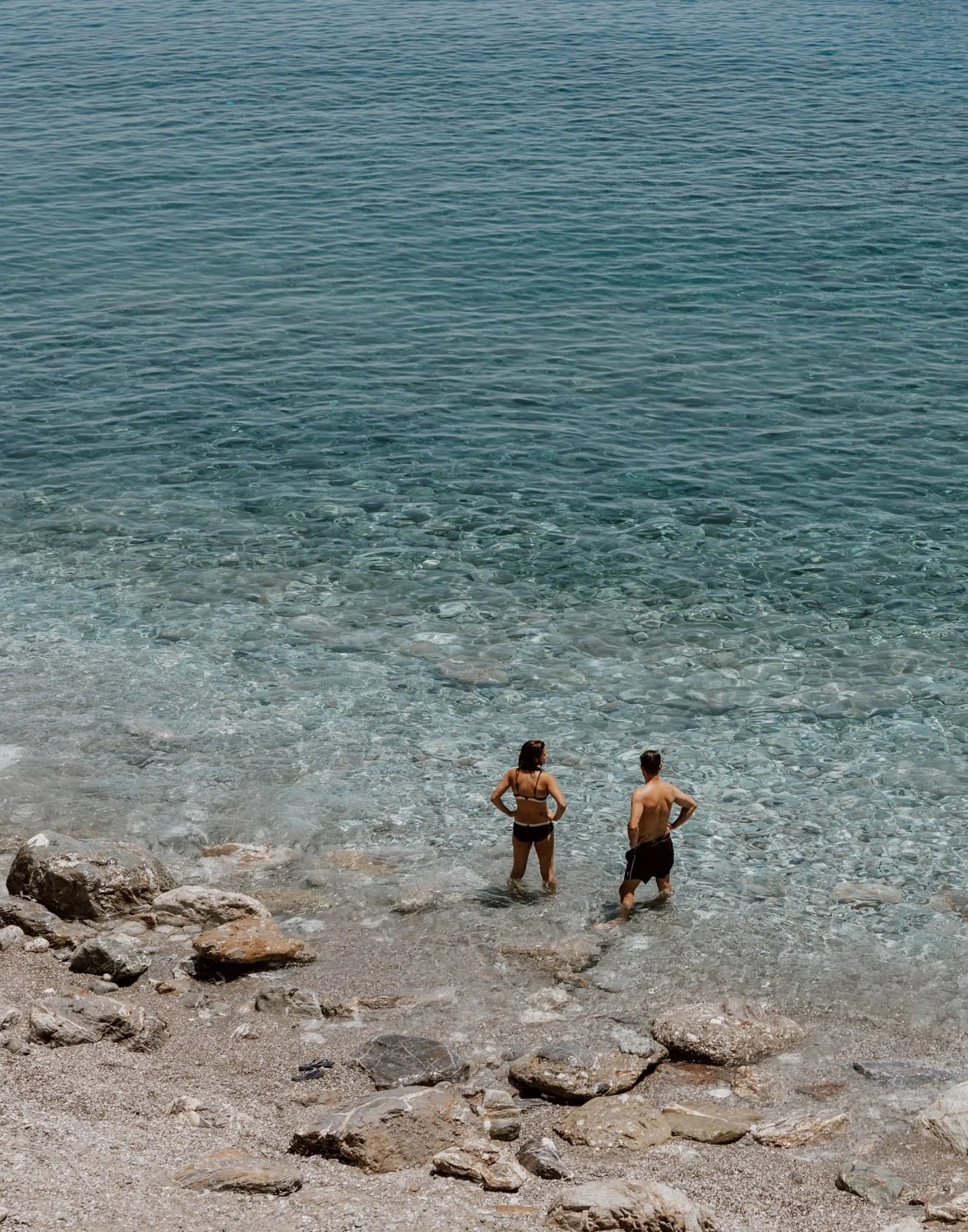
Enjoy The Chora
Every Greek island has a place called Chora.
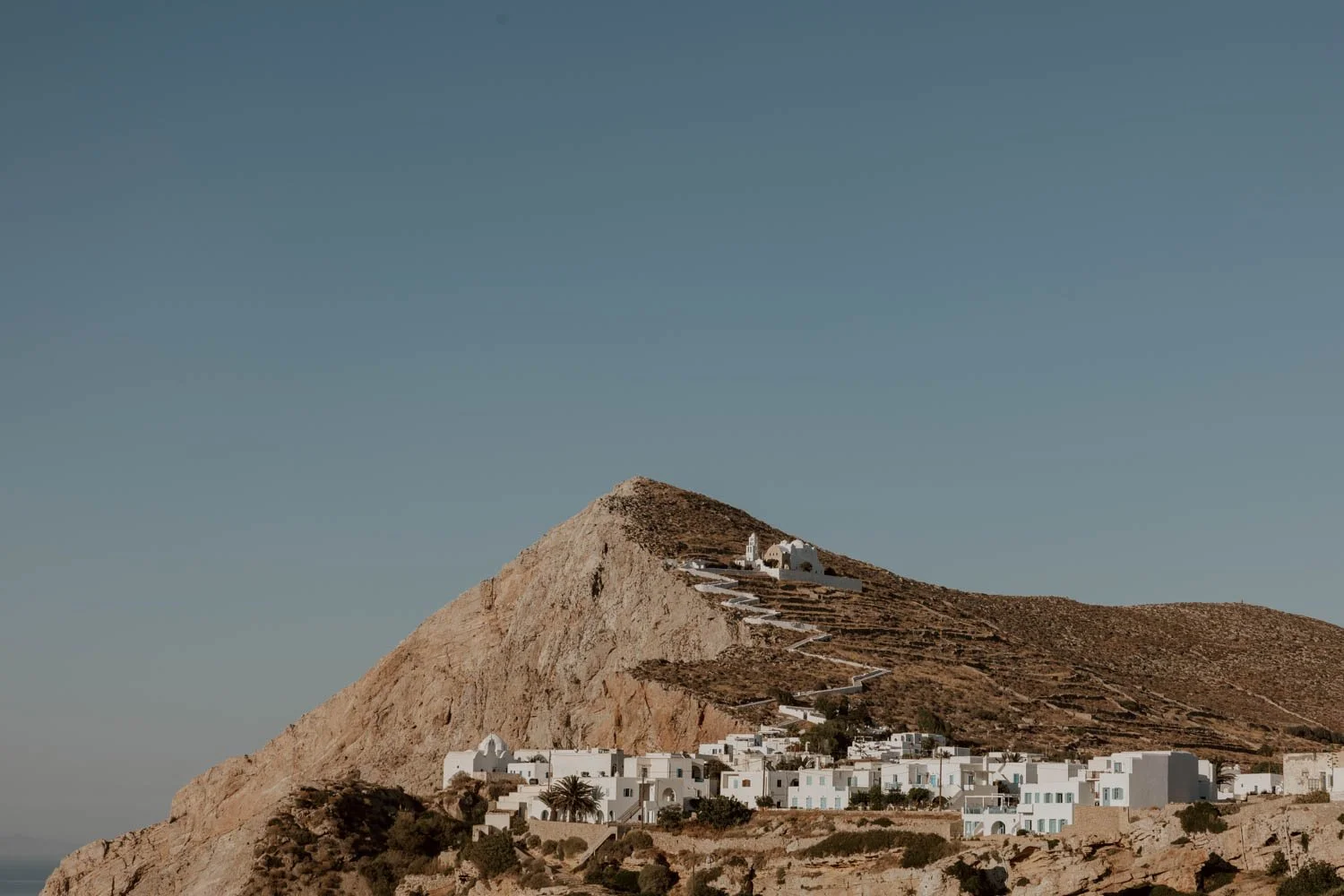
The principal, characterful village or town, usually a cluster of whitewashed houses and narrow streets twisting upward, it’s often the heartbeat of the community, a transport centre, and a handy reference point for everything else. In Folegandros, the easy-on-the-eye Chora is perched up on a hill with spectacular views out over the sea, and it really comes alive from the late afternoon until the wee small hours.
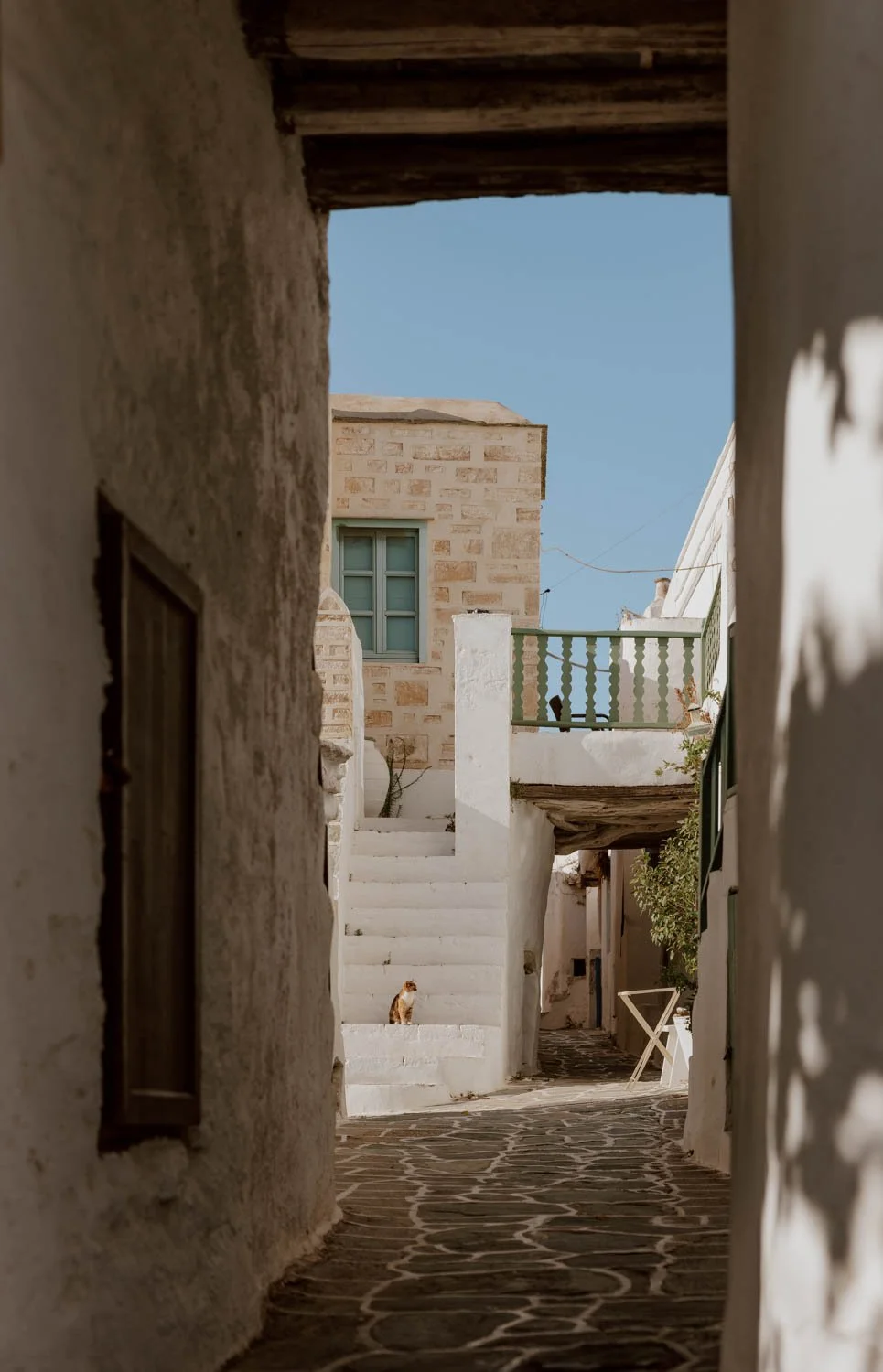
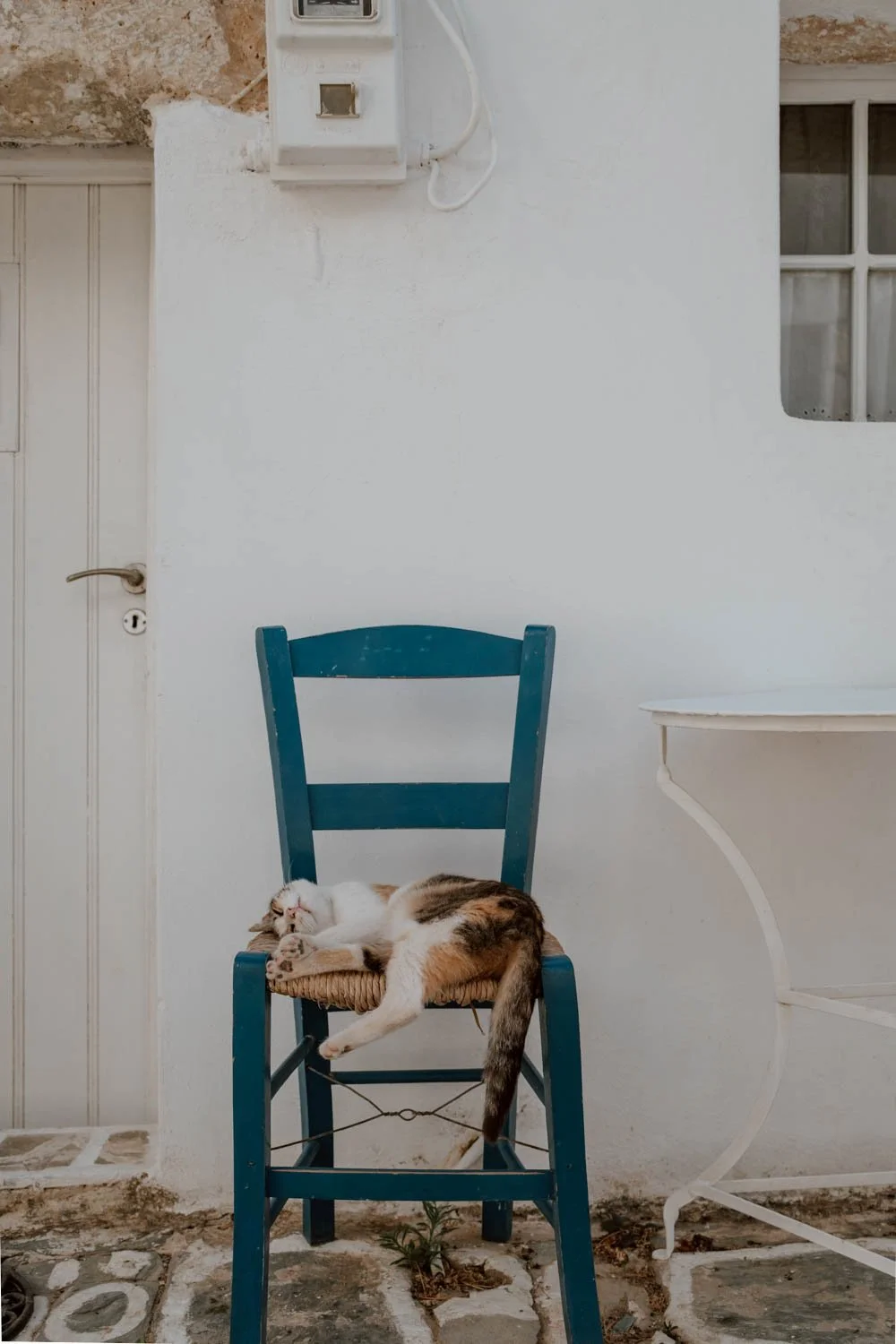
All the Greek clichés come true there: hardy old boys of winter sipping strong coffee at the local’s only cafe, a handsome Orthodox priest smoking somewhere, and a rag-tag army of cats slumbering in the shade.
On an island as small as this, you’ll always spend at least an evening or two in the Chora, whilst for others it’ll form the core part of their stay. As well as a great selection of restaurants and drinking holes to be found in the main square and down back alleys, the town has a good selection of places to stay including the new boutique hotel Avaton and Cliffhouse, a gorgeous standalone suite.
For some, it’s going to be the best choice of base, but others may prefer to stay further away and travel in (not sure which base is best for you? Check out our Where to Stay in Folegandros post).
Importantly, beyond the boutiques and the restaurants, the Chora has thankfully retained a lived-in feel both in its centre and down its backstreets.
Early morning is slow and good for a long breakfast, but if only have one opportunity to spend time in the Chora, we think from the late afternoon until your last cocktail is actually the sweet-spot. If the cats have all started to wake up and pad around, then that’s a sign you’ve timed it right; if they’re still asleep in a doorway you’re too early gringo.
We’ve shared all our favourite places for cocktails, ouzo/raki, and good food at the end of the post - and the one dish most of you can’t leave the island without trying - but you can find a few other places to seek out in Chora below.
Visit | HEAT IS LIFE is a small, super cool modern art store / gallery (maps)
Stop | The view over the sea from this terrace is divine at any time of day, but partciularly in the early evening
Walk | Strolling around the whole of the town takes less than an hour, but make sure to linger a moment longer in the tightly packed old Kastro quarter. If you’d like a local-led tour that focuses on the history, culture, and traditions of Folegandros, then consider booking a spot on Poly’s highly-rated walking tour
Know | Much of the Chora is pedestrianised, so it’s best to arrive by bus or park up for free here or here
Stay // We’ve already mentioned two of our favourites above (Cliffhouse and Avaton), but Chora Resort Hotel & Spa is a good shout if you want something more traditional, whilst other excellent Airbnbs to consider are Cottage House, Little Cellar and White Apartment.

Swimming & Serenity at Paralia Livadaki
As hinted at, the best beaches in Folegandros usually require a sweaty walk, a scramble, a dusty road drive, or a boat: if you're coming for lots of wide, long, easy-to-reach stretches, then this is not your island.
Whilst there are also two excellent beaches which are much easier to access - we cover them later in the guide - we really think you should factor in time and curiosity for at least one of the more remote options. After all, these sorts of bays and beaches are part of what makes the Greek islands quite so special, and they can still feel like a secret if you time it right.
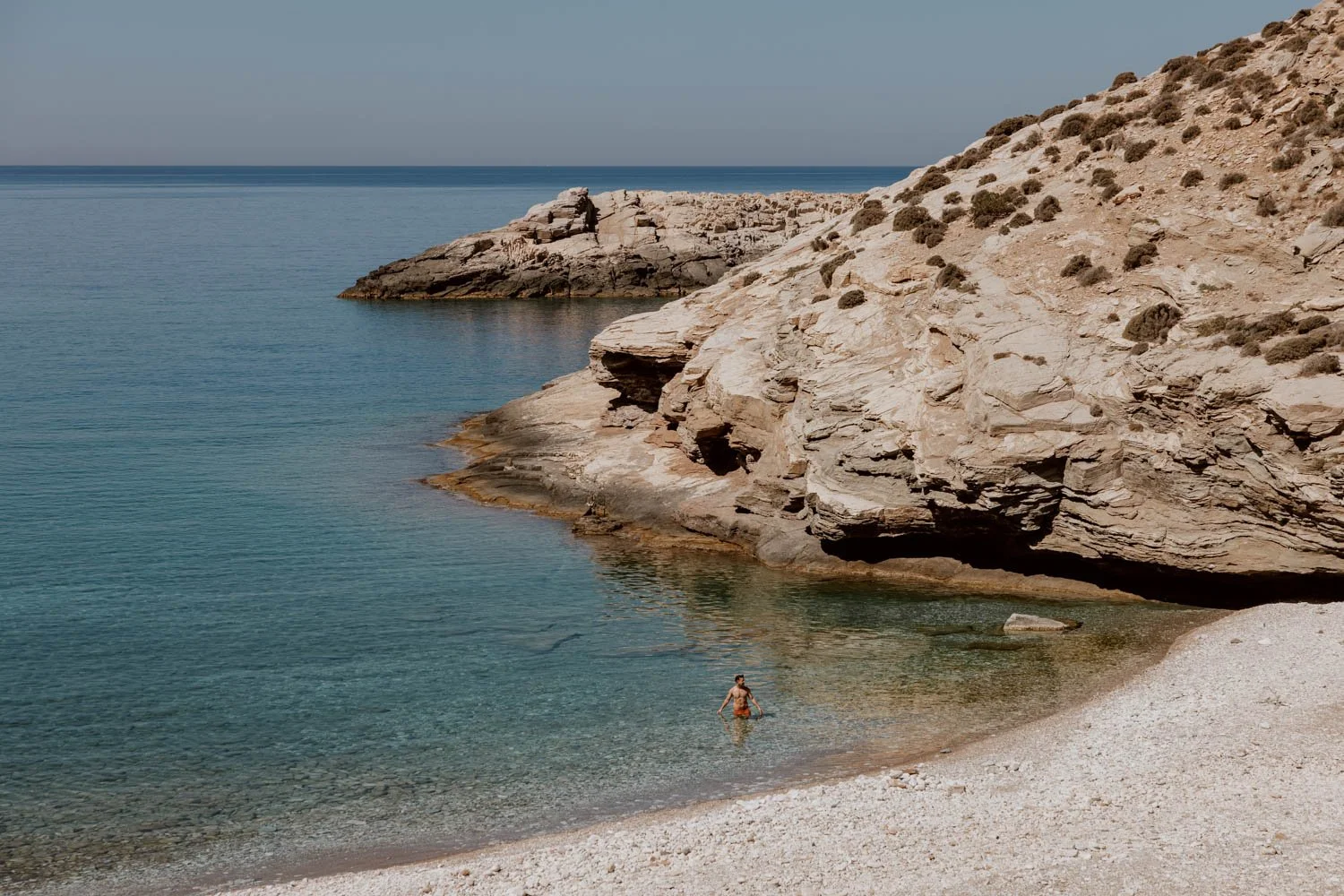
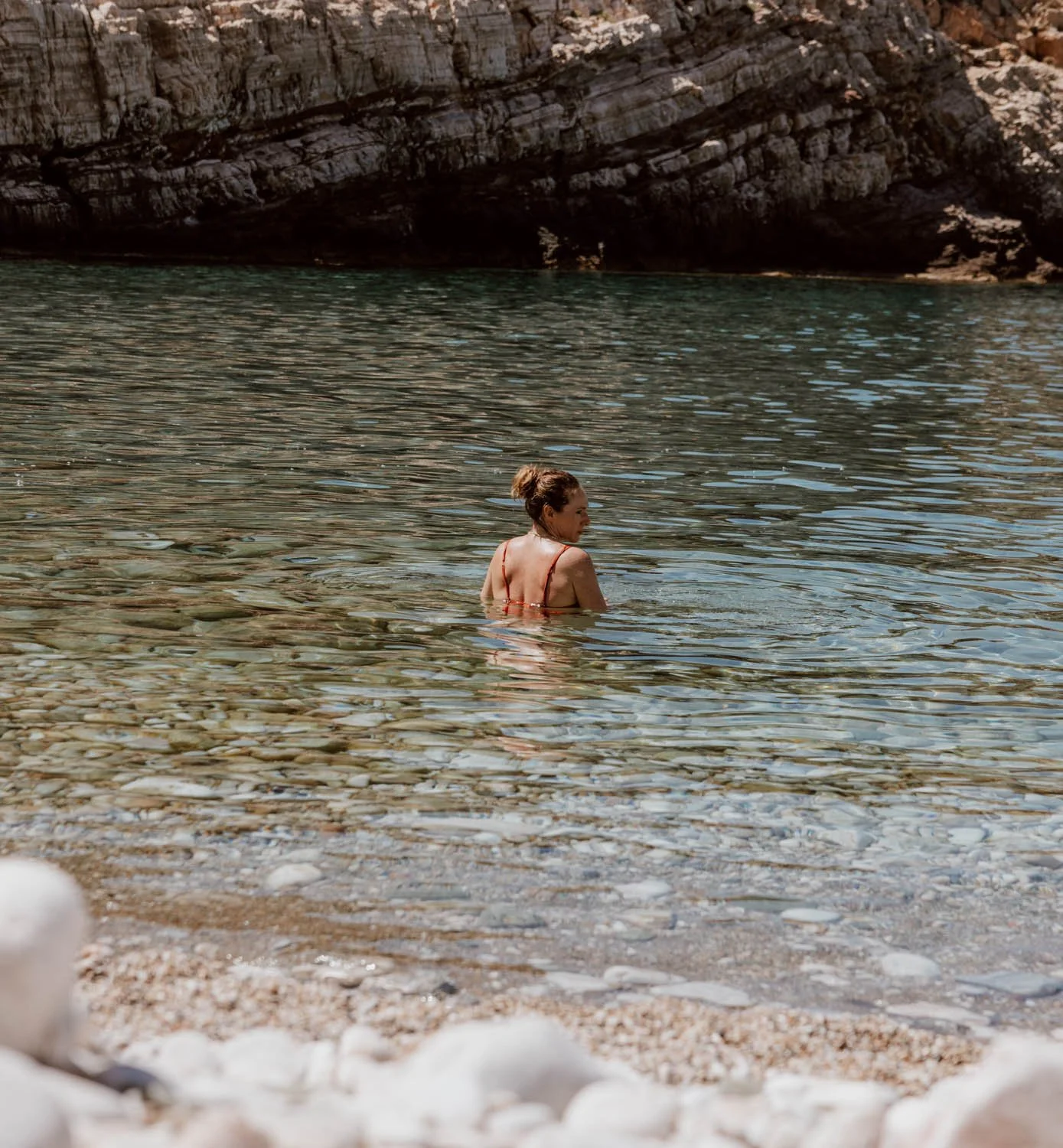
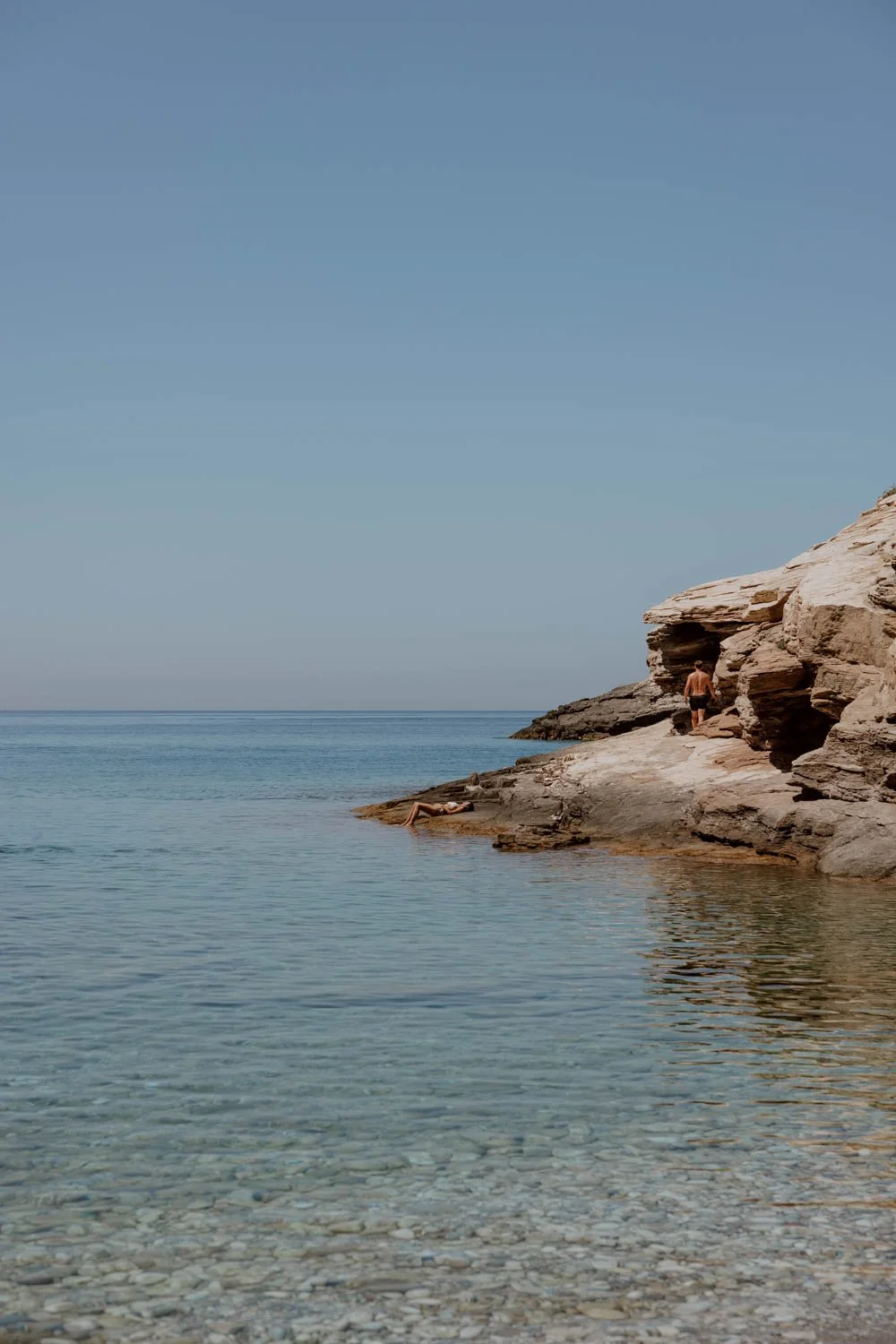
Paralia Livadaki (maps) certainly meets that brief, and we were fortunate enough to be the first to arrive there one bright, sunny morning. Bookended by two steep cliffs, it offers incredibly clear and calm waters - truly like a swimming pool - and is absolutely worth the effort of a scenic 40-minute walk in (or the price of a boat taxi).
Know | The beach is very stoney with smooth pale grey and white pebbles, and backed by olive trees where people get shade or leave their bags and bikinis hanging off branches. However, it’s important to emphasise that the back of Livadaki isn’t that postcard pretty. However, this place is much more about the swimming, the setting, the smooth outcrops you can swim out to, and the overall serenity on offer.
Boats | You can take the Island Spirit boat taxi from Agali to Livadaki, with departures at 11am, 1pm, and 3pm (2025 schedule). Travel time is about 15 minutes, and it’s €8 one-way or €14 for a return ticket.
This also includes an optional stop at Agios Nikolaos beach, so our recommendation would be to get the first departure for a slow morning on Livadaki, then head to Agios Nikolaos for your late lunch and another few hours at that beach.
The boats back from Livadaki to Agios Nikolaos & Agali leave at 11:20am, 1.20pm, and 3.20pm - there may be a later last boat in peak summer, so double check schedules once you’re on the island.
Alternatively, most island boat tours include some time on Paralia Livadaki.
Drive & Walk | You have two options, and for both we recommend setting off before the heat has become too intense. As it’s mostly rocky and uneven underfoot - definitely more trail than 'path to a beach' - you should wear trainers / shoes / hiking sandals, never flip-flops.
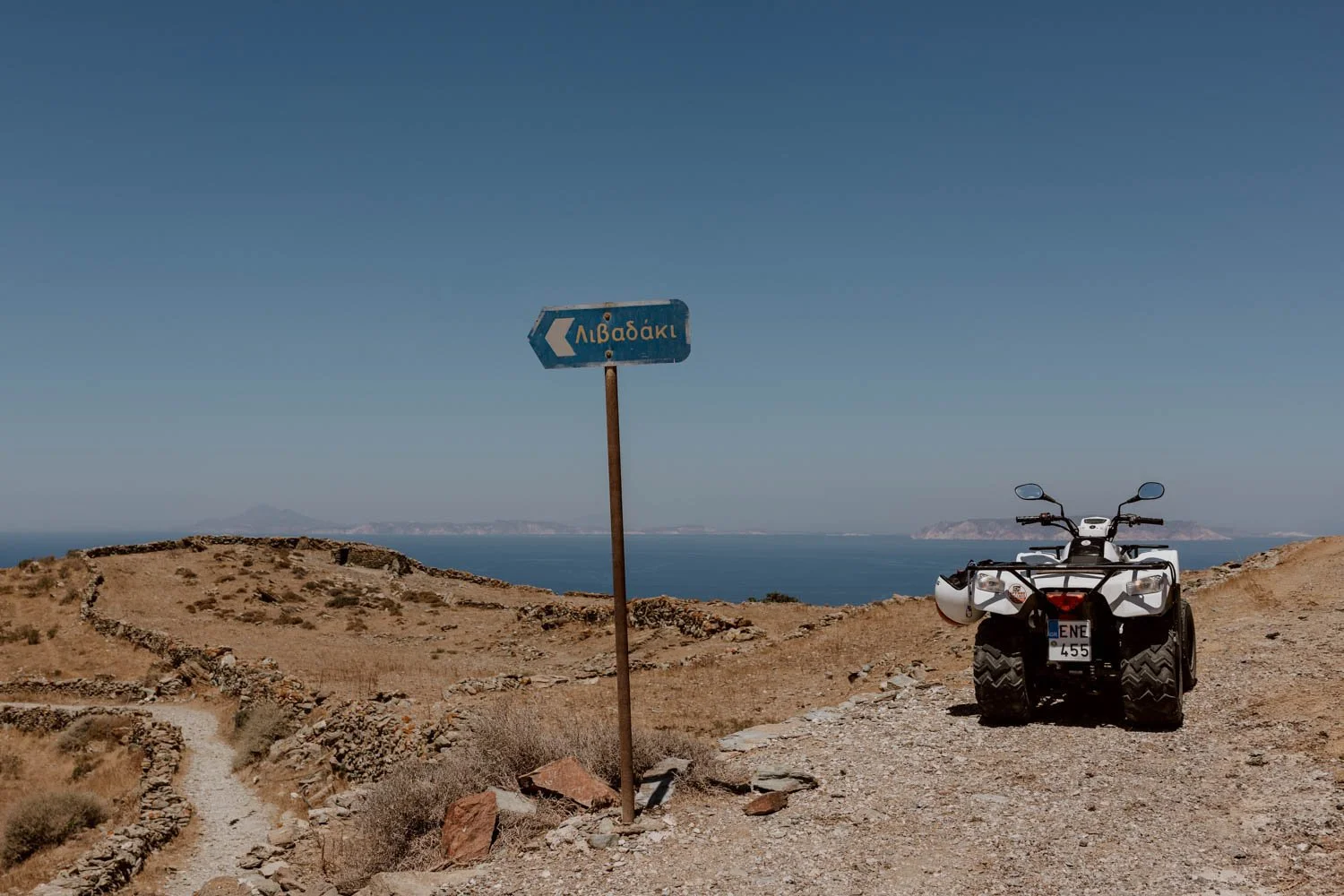
1/ What we did. Park up at the side of the road close to the trailhead - here on Google Maps. There’s only space there for a few ATVs and cars, so do try to pull in tight to optimise what’s available. There’s a clear sign for the trail, and you simply follow that in the direction of the church you can spy atop the hill.
If you don’t have your own wheels, then you should either start from the village of Ano Meria and follow the road for about 20 minutes to reach the start or see if the bus will drop you off a little closer to the trailhead.
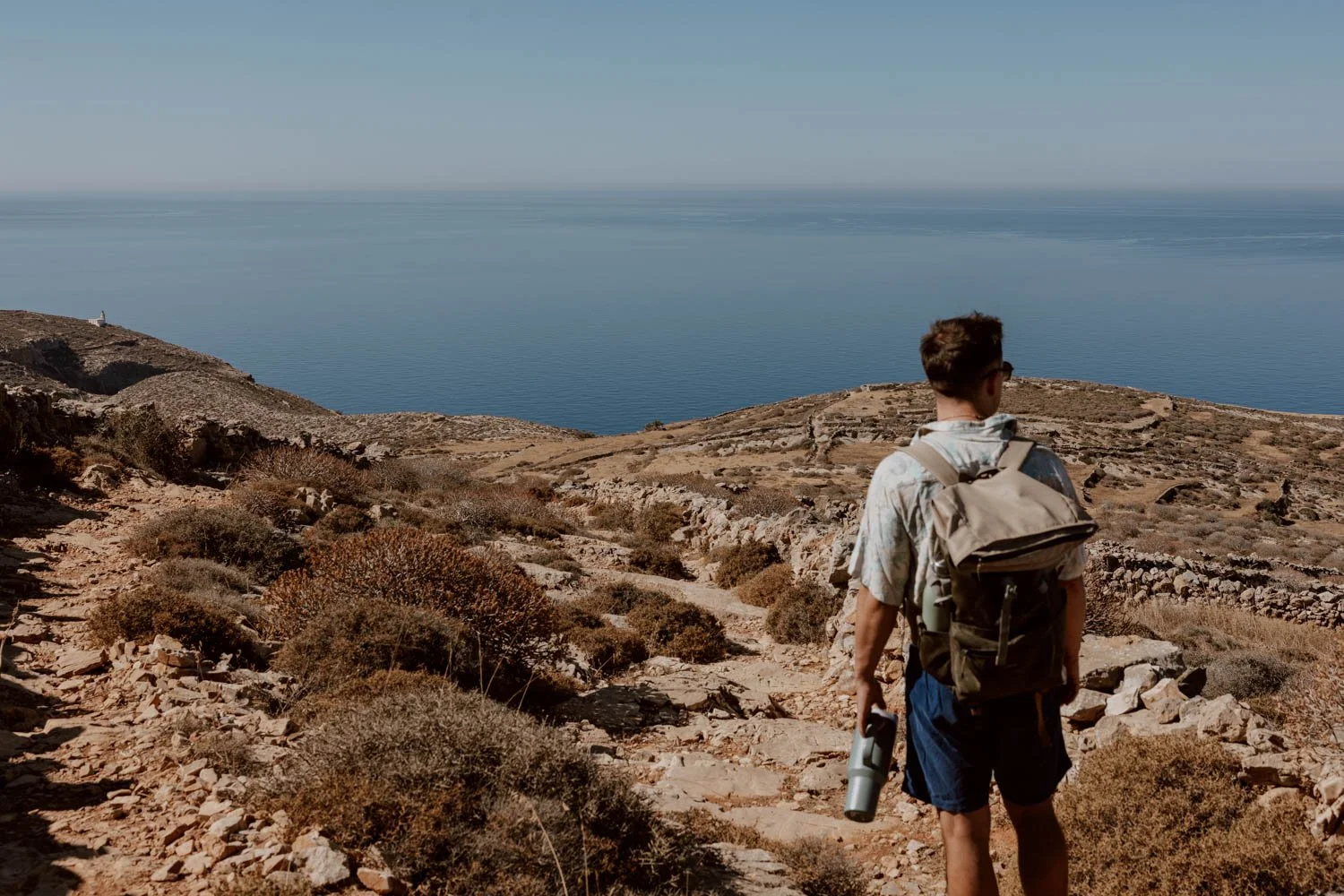
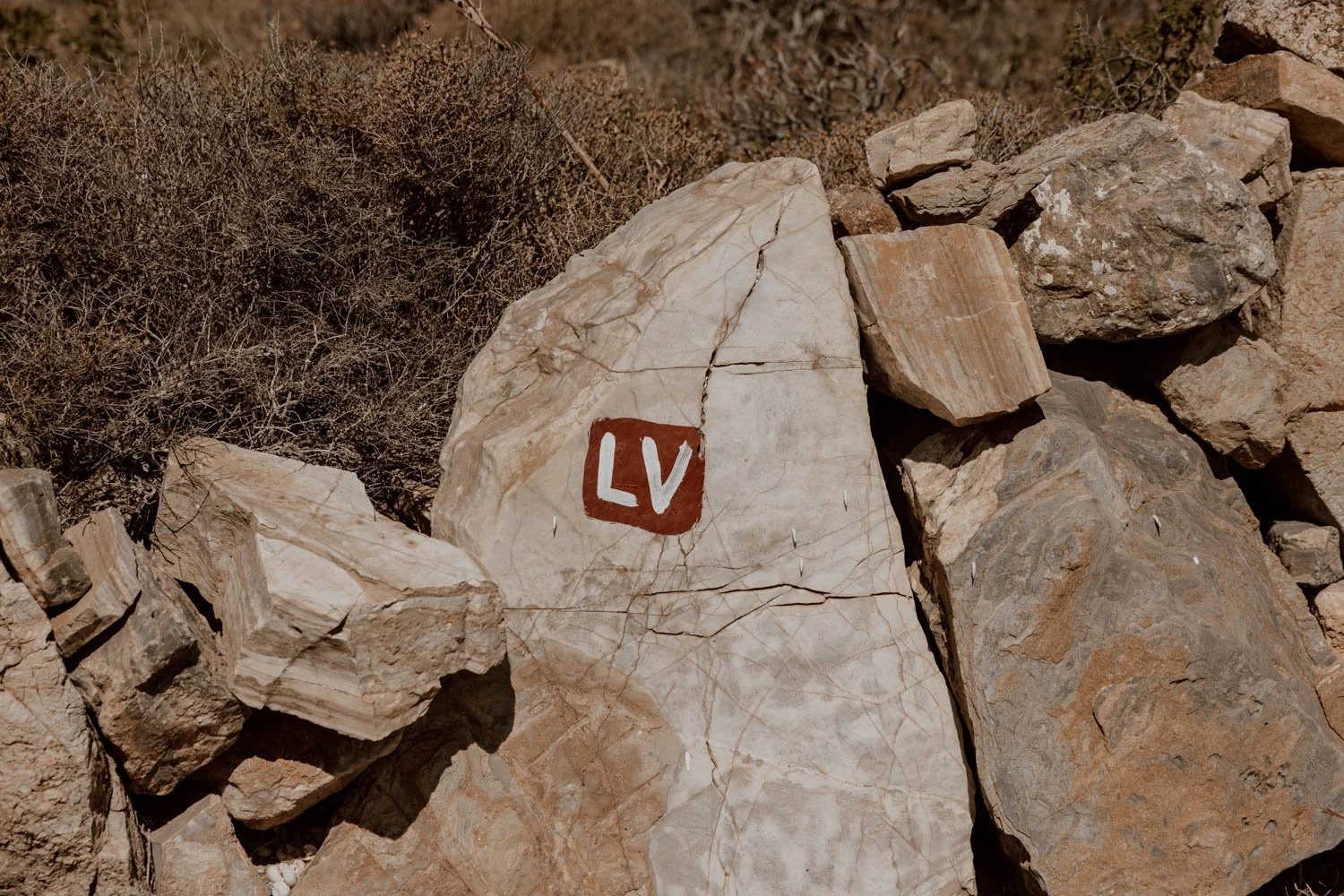
On the trail - which is part of the official #5 hiking route - there are hand-painted signs with LV in white text on a red square. Keep an eye out once you reach the church for one on the ground saying ‘Lividaki 2.1km’. From the parking spot, it took us 40 minutes to descend down to the beach at a reasonable pace, and the views were excellent throughout. Very peaceful too.
On the way back up, you return the same way you arrived, but do need to keep an eye out for LV on the rocks as it's easy to veer off track. The walk up to our ATV took us 40 minutes with a few water + rest stops along the way. Zero shade, so wear a cap and ensure you’ve kept enough water for this.
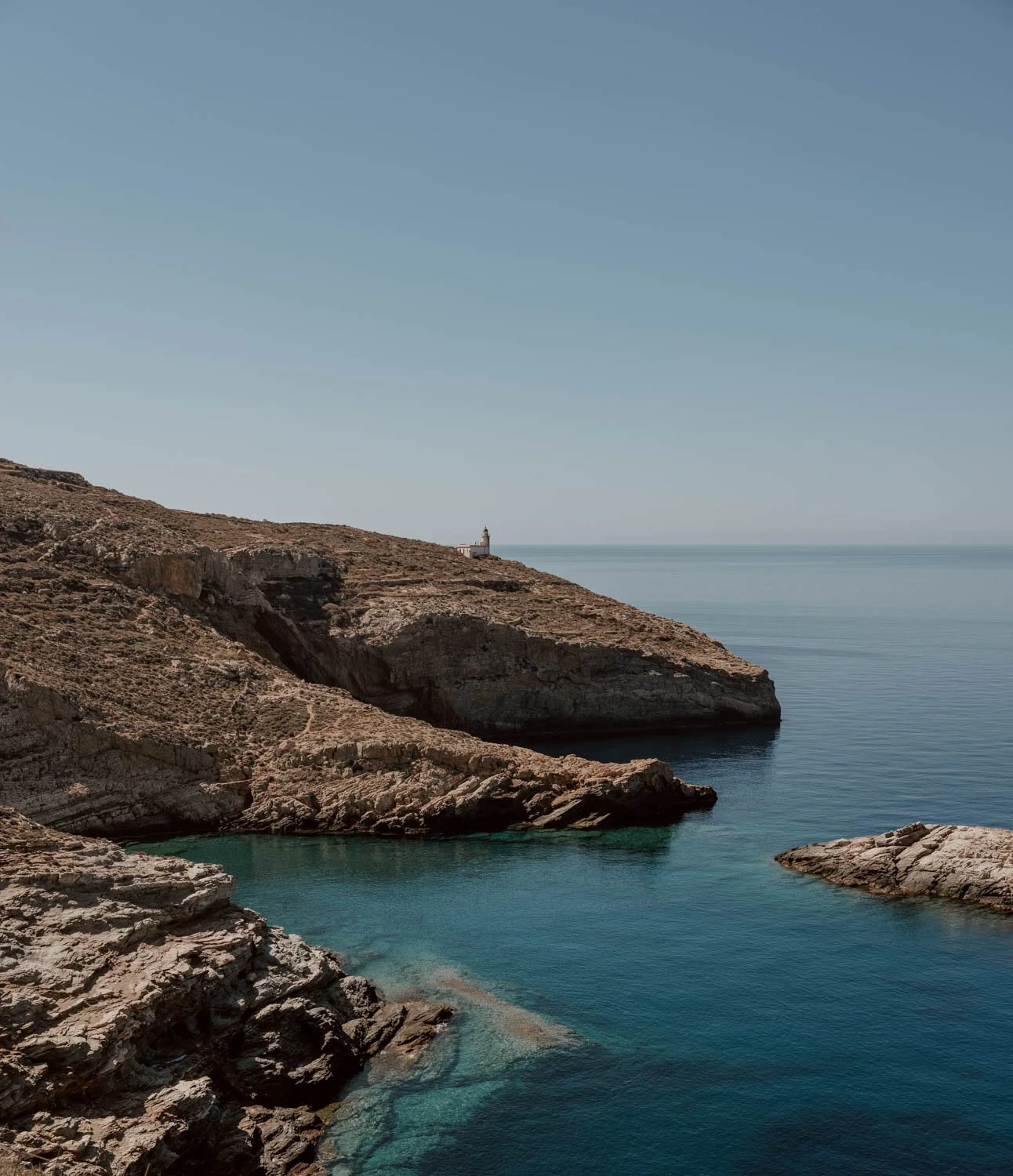
2/ It’s also possible to walk to Lividaki via another section of the #5 hiking trail, which follows the coast in the opposite direction and arrives by way of the Aspropounta Lighthouse (maps)
Bring | There are no facilities on the beach, trail, or in the immediate vicinity, so you need to take absolutely everything you need and plenty water (more than you think you’ll need). There are some trees for shade down on Lividaki, but it’s minimal.
Travel Tip // As with Paralia Katergo, the secret to getting some time with the beach at its emptiest is planning to arrive before the taxi boats. As you may have surmised from the timetables, the first tours generally arrive on Lividaki around 10:45am, followed by the first boat taxi at 11:15am. We got down there at 10.20am, but note that much of the beach would still have been in shade if we’d arrived much earlier, so perhaps don’t set a ridiculously early alarm.
Sunset from The Church of Virgin Mary
The cliffs and contours of Folegandros deceptively spread the tourism out during the day, but this sunset ritual brings everyone together in one place.
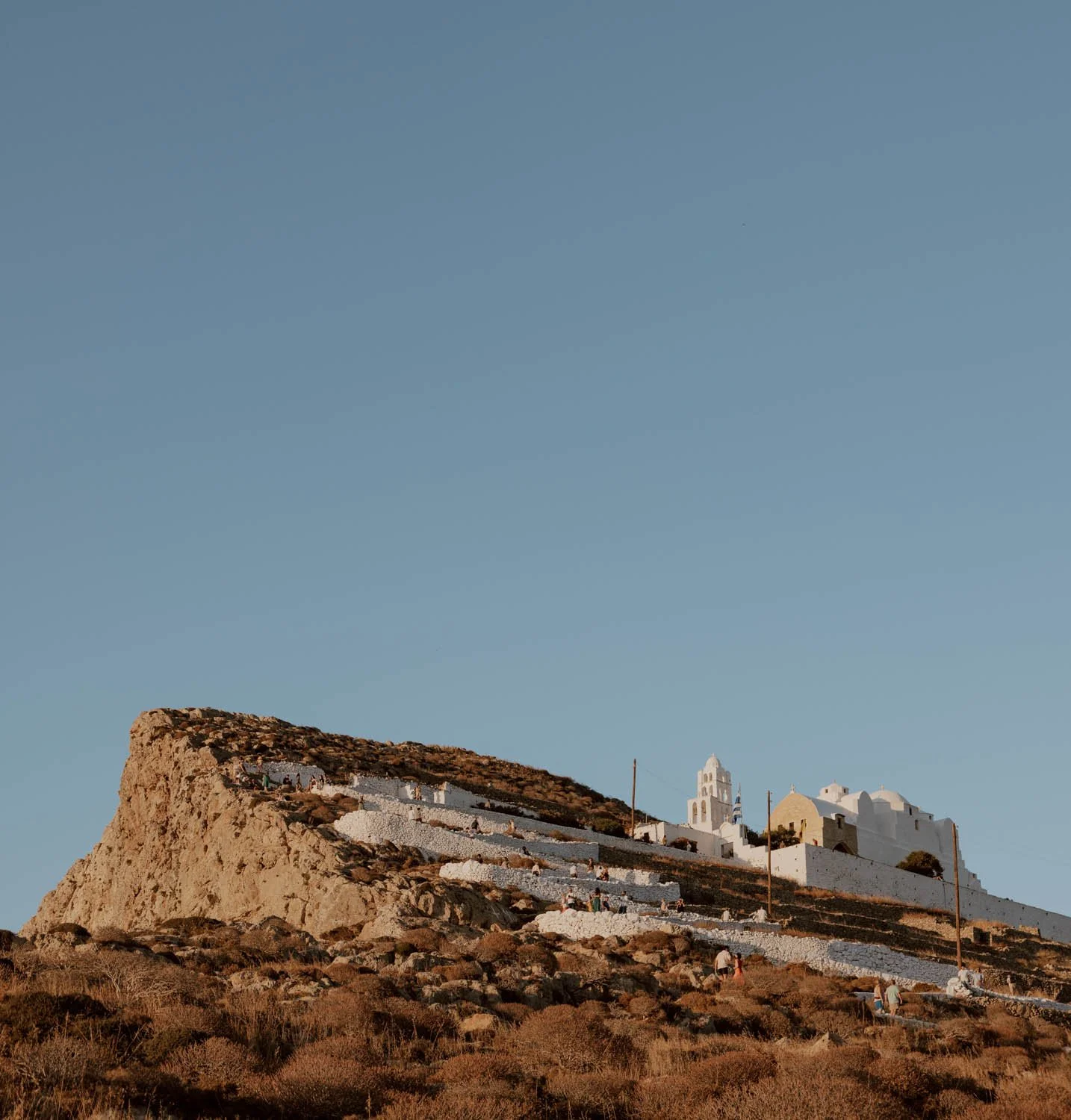
From its privileged position on the hill slope, the church (also known as the Church of Panagia) overlooks the Chora and is a focal point of the island. Its current iteration was completed in 1821, but a holy building has been here for much, much longer. The largest church on the island, its Virgin Mary is revered as the protector of Folegandros for its pirate-sinking powers. Locals still bring it out and carry it around the community in Easter.
Rather than for its religious or architectural qualities though, most climb those stark white zig-zag stairs purely for the view and the atmosphere in the early evening light; we often say a sunset is the closest thing to a shared religious ceremony amongst travellers these days, so the irony of walking to the church for sunset rather salvation isn’t lost.
Note that this probably the single most popular thing to do in Folegandros, and it can become quite crowded up there - if you want to get a particular spot, you should set off earlier than others.
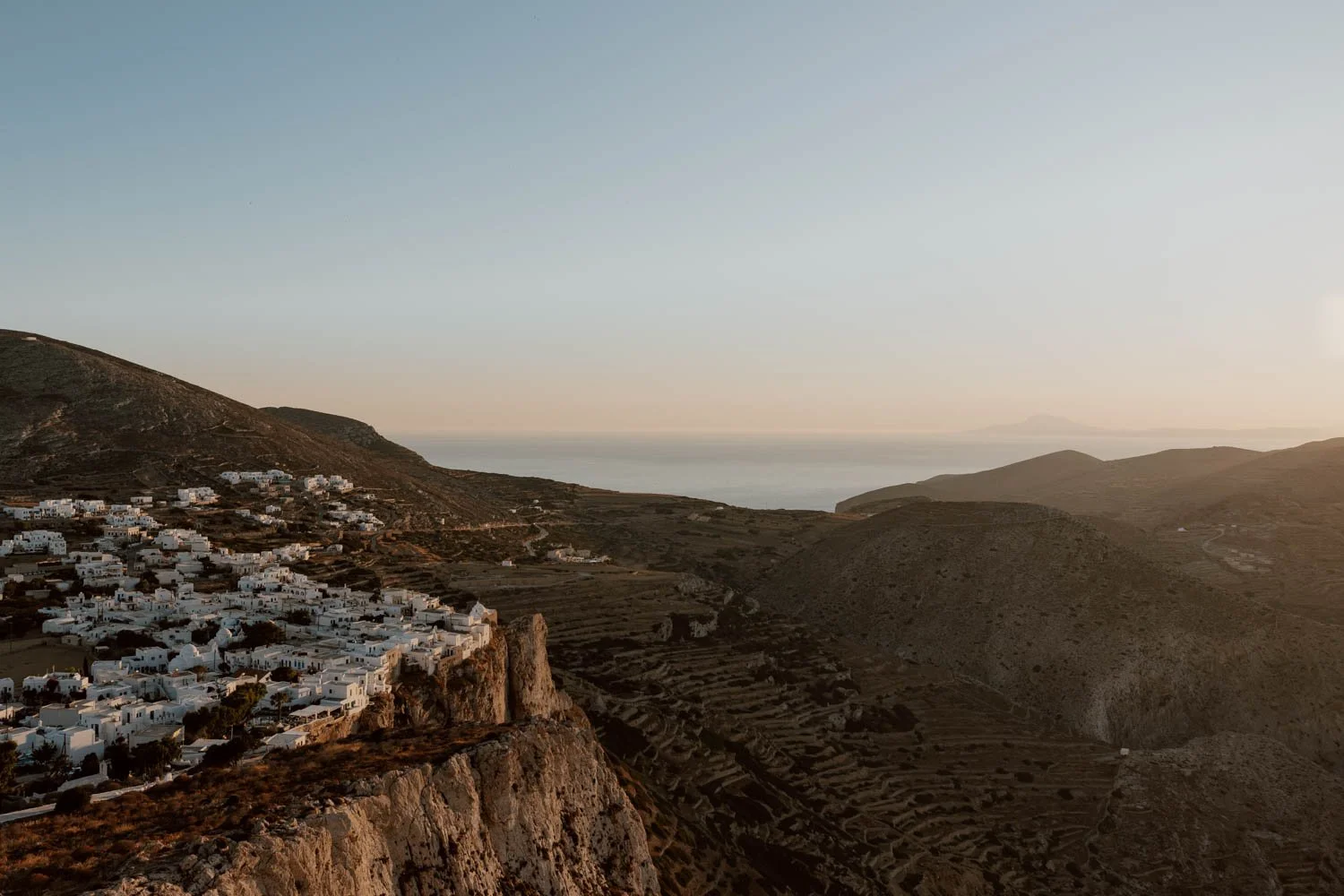
Where | You can find the church here on Google Maps, but you will start the walk uphill from this spot in Pounta Square in the Chora. The stairs will not be taxing for most, but some grannies got abandoned at the bottom whilst a few gave up and just enjoyed the view from half-way.
When | The interior of the church is only open from 6pm until sunset, the time of which obviously varies a little during summer.
Know | It’s a good idea to plan ahead and check that day’s sunset time, and give yourself about 15 minutes for the walk up (many will be quicker).
From the evidence we saw though, a lot of people underestimate both the time required to walk up and / or the sunset time. The best way to avoid an argument - and a sweatier walk than you want - is to aim to get up to the church about half an hour before the sun sets. This lets you take your time on the stairs, seek out the various viewpoints during golden hour (as beautiful as the sun set), and then find yourself a good spot for the main event.
Dress | If you are planning on entering the church, it’s essential to wear the appropriate clothing and act respectfully. Also, as most people will pair the sunset with cocktails and dinner in Chora afterward, it’s a good idea to wear comfortable, stylish clothes and shoes you can actually walk up to the church in - think sandals or low heels rather than fancy stilettos!
Travel Tip // Want another option for another sunset on Folegandros? Then check out the terrace bar at Anemomilos (maps), which you’ll pass on the left as your walk up the hill to the church. It wasn’t our vibe for drinks, but it may be yours.
A Morning at Paralia Agali…
Found in the centre of Vathi Bay, this is the main beach on Folegandros and also goes by the names ‘Agkali’ and ‘Angali’.
It has all that signature sandy beauty you’d expect, but its popularity is mainly due to its proximity to the Chora and the fact a bus also goes straight down there; this makes it one of the most accessible beaches on the island. Due to this, it’s also the beach that has most in terms of restaurants, parking, accommodation and other amenities, meaning Agali is a great shout for those just looking for a lazy beach and long lunch sort of day, without the need to bring in everything you need or worry about driving off-road.
It’s also super family-friendly, and nudism is explicitly forbidden.
So, if that’s exactly what you’re looking for, Paralia Agali should 100% be in your sights - and this is also the main departure point for taxi boats to Lividaki and Agios Nikolaos.
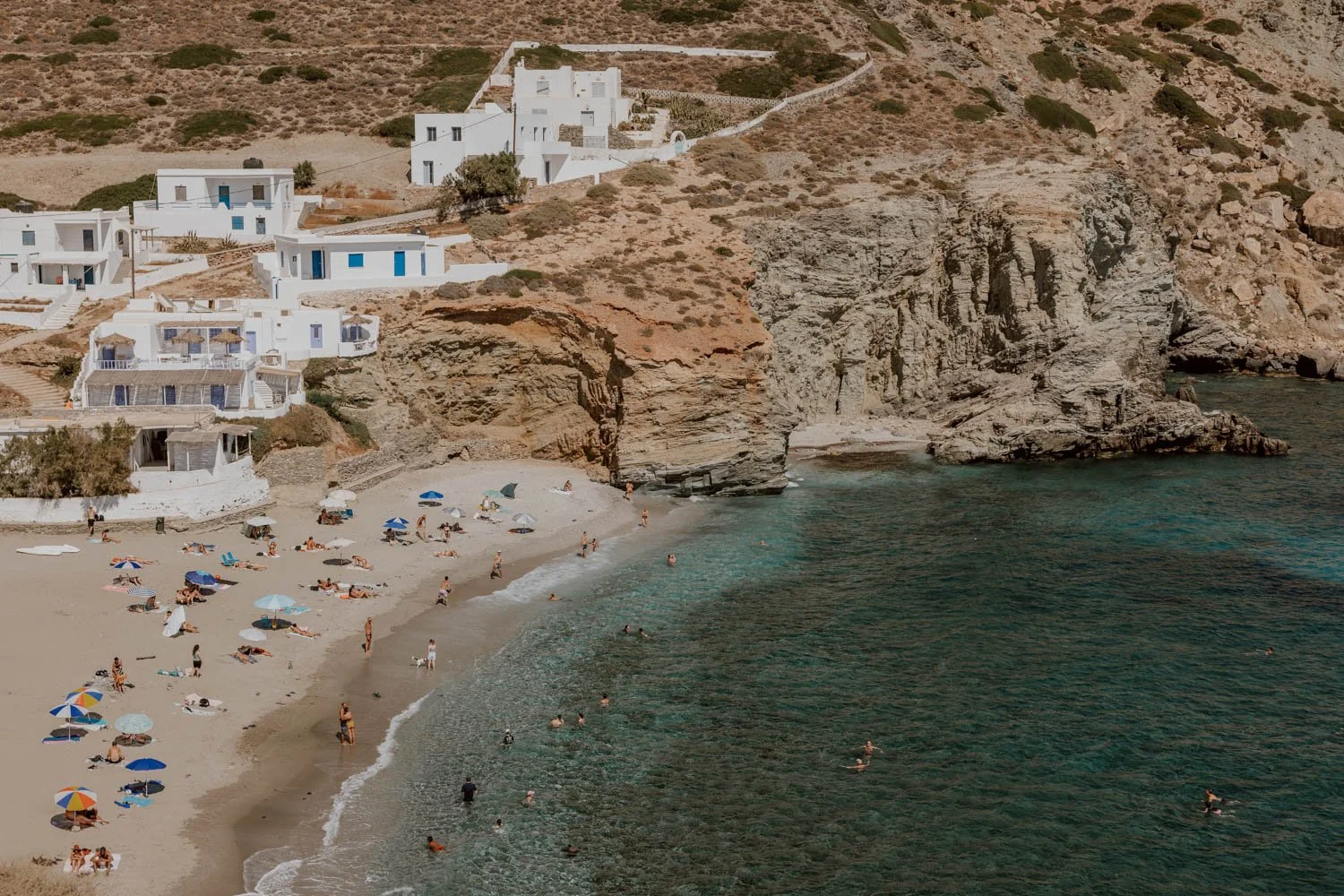
Where | Find it here on Google Maps
Go | There is a direct bus from Chora to Agali beach that takes just 10 minutes and costs €2.50 each way. Last year it was possible to buy these at the bus station but we believe these must now be bought online (do let us know in the comments). The first departure is at 9.30am, with departures nearly every hour following, and the last bus back to Chora is at 7.30pm. Schedules do change throughout the season, so we recommend confirming times on the official website.
You can also take the regular bus that runs the length of the island, but this will drop you off at the top of the hill and it’s 1km down to the beach - not a good idea if you’ve got luggage.
If you drive to Agali on a scooter / ATV, do go slow on the big downhill road as there’s a lot of traffic both ways. It’s paved and mostly smooth going, but there are some bends to take care on. You’ll find a large, free car park on the right hand side, a short walk from the beach.
You can also walk down there via the #1 hiking trail from Chora (3.6km - 90 minutes), or do the trail in reverse. It’s labelled as ‘easy’, but you should only attempt it in suitable conditions and temperatures.
Bring | There’s no beach clubs or sunbeds etc for rent, so you still need to bring your own towels and parasol. There are public toilets though!
Know | The little cove beach of Paralia Fira (maps) is to the left of Agali, and accessible via a five-minute walk along the trail. Agali’s port is also the place to get the taxi boat to Livadaki, the remote beach we mentioned earlier in this guide.
Stay | There are a handful of places to stay here, and our picks are: Blue Sand Boutique Hotel is our number one pick, but if you’d prefer an apartment, take a look at Perigiali Family Apartment and Theros Apartment.
…Or Walk The Coast to Paralia Agios Nikolaos
Alternatively, for a different sort of vibe and setting, you can continue on to Agios Nikolaos beach.
This gorgeous little enclave lies a bit further along the coastline, and is only accessible by boat or on foot from Paralia Agali. We chose to walk, and had a very leisurely late afternoon stroll along the rough, narrow trail. It’s only about a kilometre, mostly flat, with some fantastic views along the way, so this is one to enjoy rather than endure.
Most visitors, however, opt to arrive via the boat taxi.
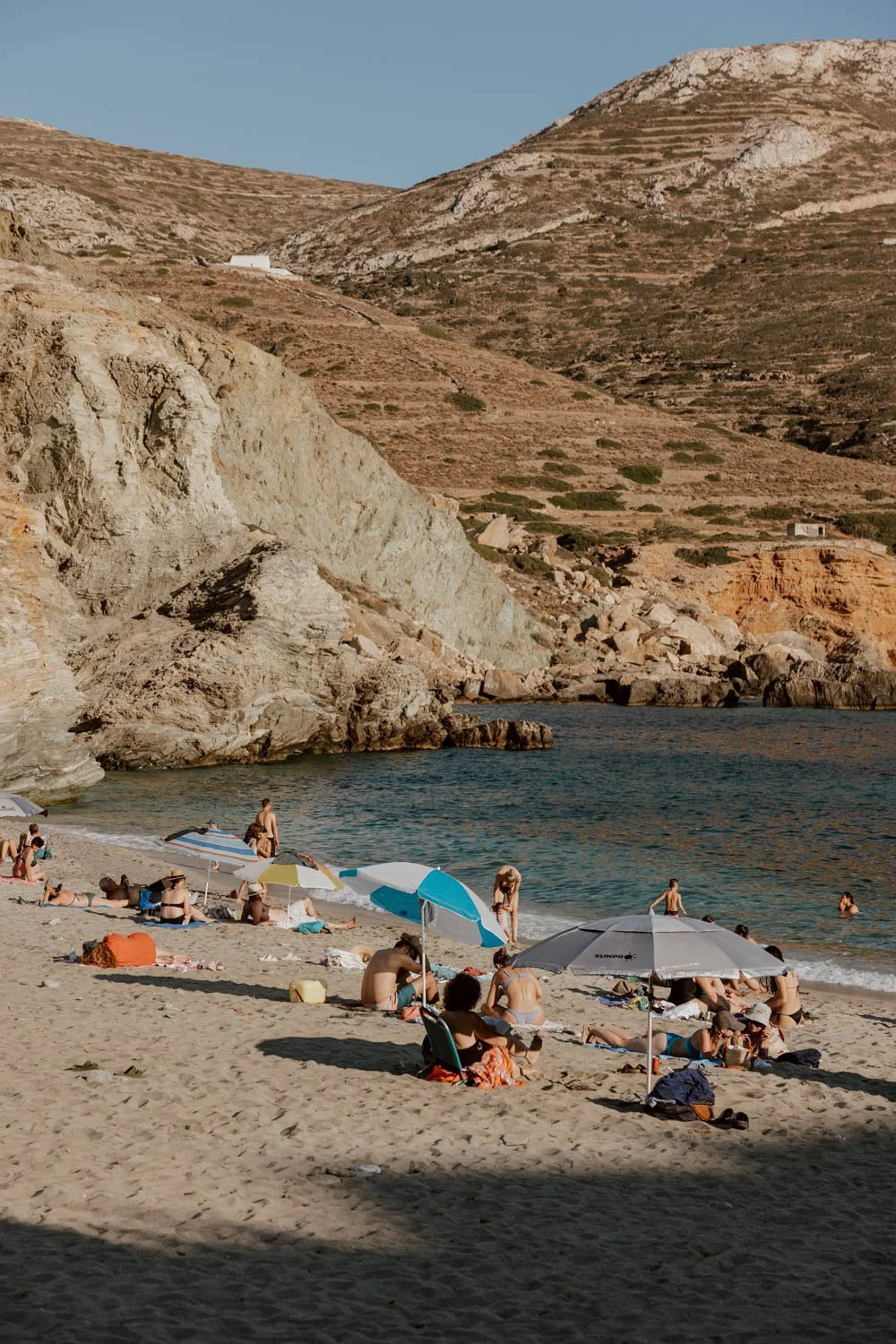
Agios Nikolaos has a relaxed, chilled atmosphere in its sheltered bay. The beach is mostly rough sand, shingle, and small stones, backed by olive trees and a few fisherman huts. Unlike most of the beaches in Folegandros, it embodies the rustic ‘Greek island’ beach aesthetic whilst also having a couple of restaurants / bars just steps from the sea.
Its relative seclusion, combined with easy access by boat and places to eat & drink, pushes the beach right up many people’s lists of things to do in Folegandros, and so it will always be a little busier than you may expect.
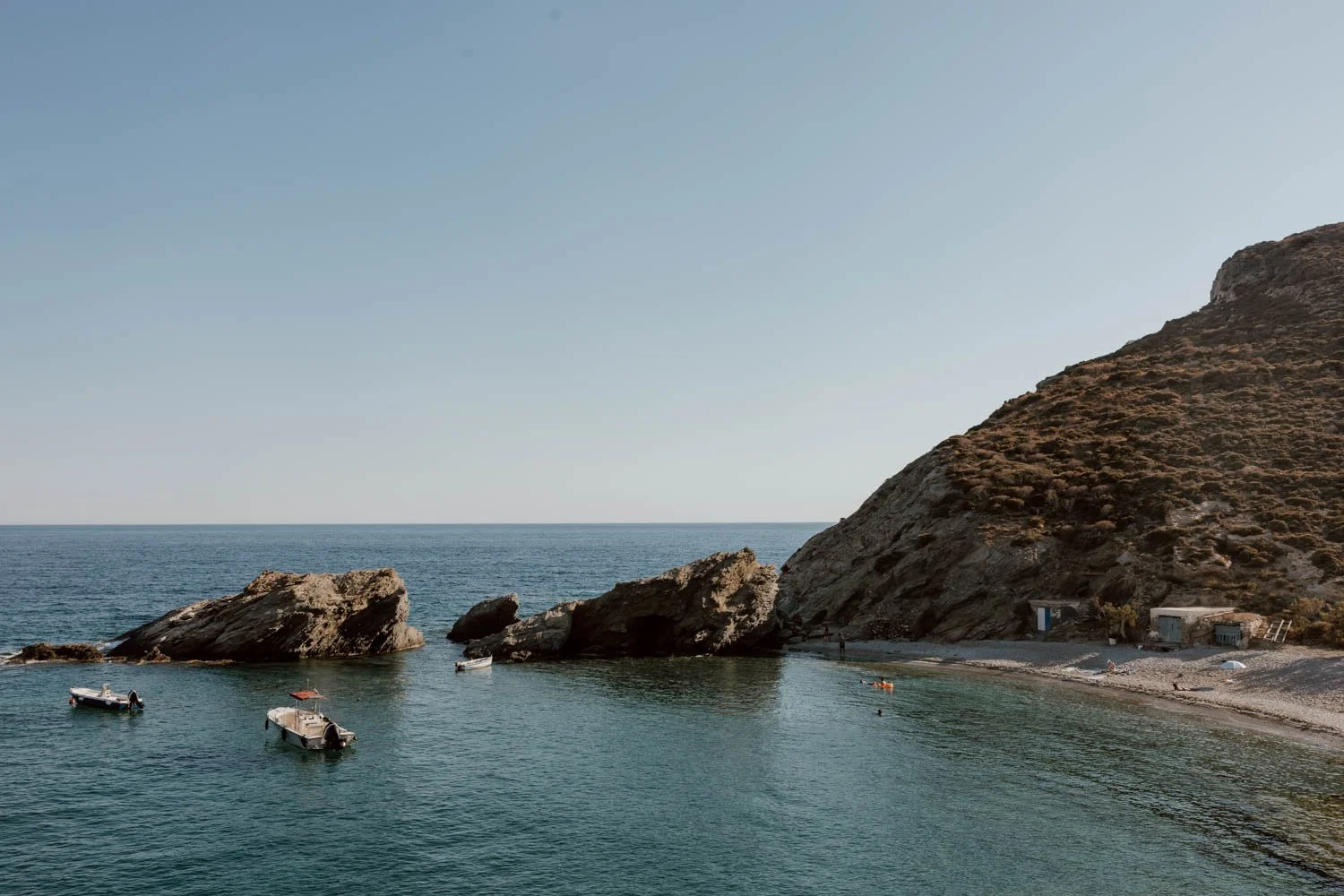
Where | On the south side of the island, find it here on Google Maps
Boat | There are currently two taxi boats from Agali to Agios Nikolaos beach, and the travel time is only about five minutes. Agali-1 Excursions starts at 10am, with departures then every hour on the hour - you can buy tickets at their Agali Beach office from 9am.
Alternatively, Island Spirit’s first departure is at 10.30am, then every hour on the hour. It costs €3 one-way, €5 both. As mentioned earlier, this boat also continues on to Lividaki, so may be the better option if you’re looking to cover more of the coast in a single day.
Walk | Whilst the boat offers a convenient way in for those with limited mobility, small children, or a general ‘can’t be arsed’ vibe, we’d suggest doing at least the walk in if you can - partly because we can still recall that first sip of cold beer at the end of it, but partly because it’s really enjoyable if you avoid the peak heat.
To access the trail, simply take the stairs up on the right hand side of Agali beach and trace the coast - this is roughly the spot where the trail starts (Google Maps). You’ll see a few hand-painted signs pointing you in the right direction, and note that you’ll have to walk through the Papalagi Seafood in order to get down to the water.
Give yourself about 15 minutes or so, and there’s no need to rush. Shoes, trainers, or sandals recommend, not flip-flops.
This path actually forms part of the #2 hiking trail, which runs from the Ano Meria and the Folklore Museum to Agali beach (3.2km - 1h 45 mins - Moderate).
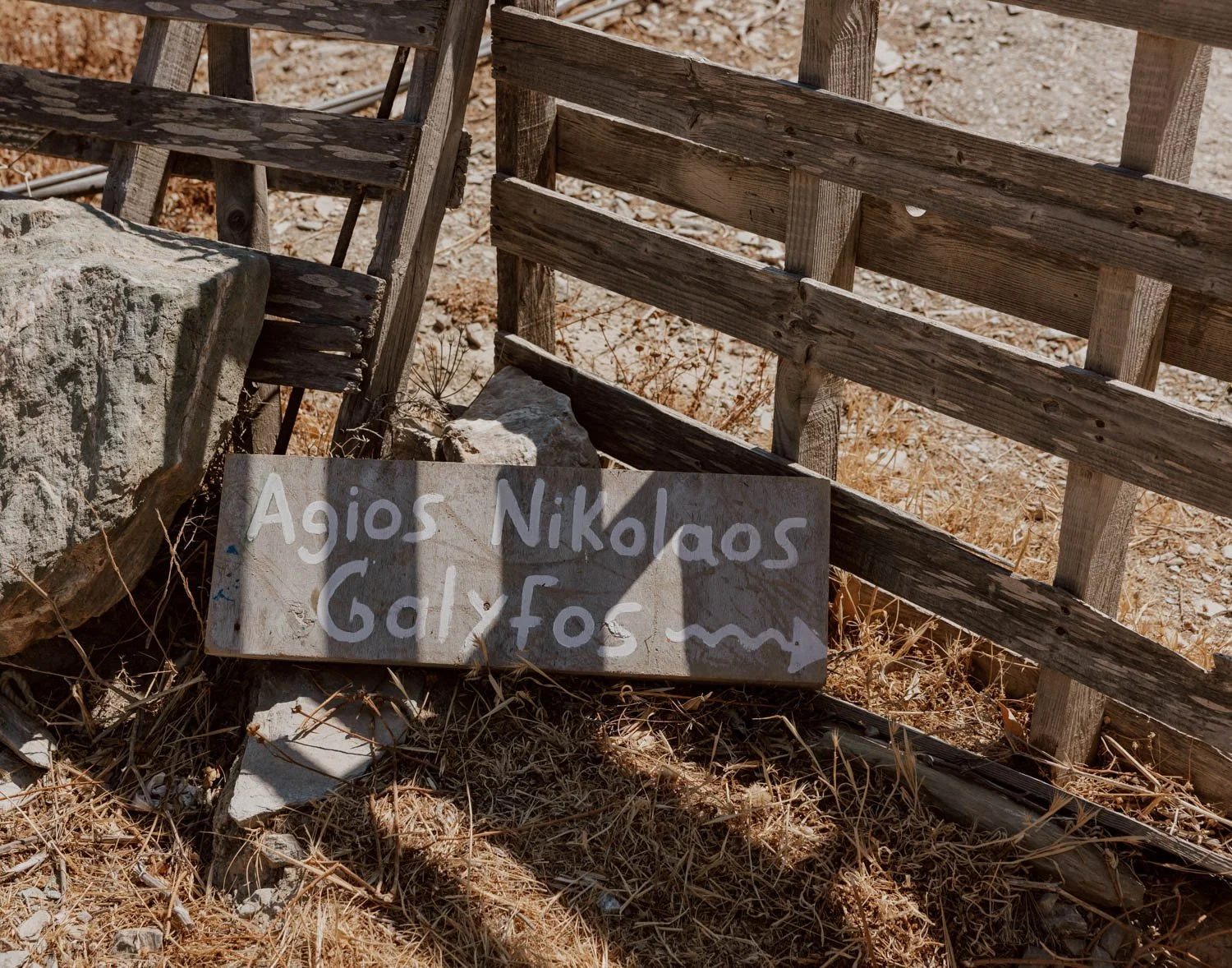
The added benefit of walking in or out from Agios Nikolaos is that you pass by the little, lesser-known sandy beach of Galifos (maps). It’s a nudist favourite and backed by the colourful no-electricity Galifos Eco Houses, so may be something that suits some travel styles down to a tee.
Bring | No beach clubs or sunbeds, so you need to bring in your own stuff. However, the facilities mean you don’t need to worry so much about drinks or food - just bring plenty cash just in case. Be aware that, as everything here needs to be brought in by boat, prices may be a bit higher than elsewhere.
Stay | No accommodation on the beach
Top Tip / / We hung out and loved the atmosphere (and little lion dog) at the rustic Taverna Agios Nikolaos (maps). It’s popular to eat there in the evenings, but you must book in advance and they bring you back with their boat - we only found out about this when visiting, so we’d love to know your experience in the comments.
Hang Out in Karavostasis
Some may only see Karavostasis on the day they arrive and the day they leave.
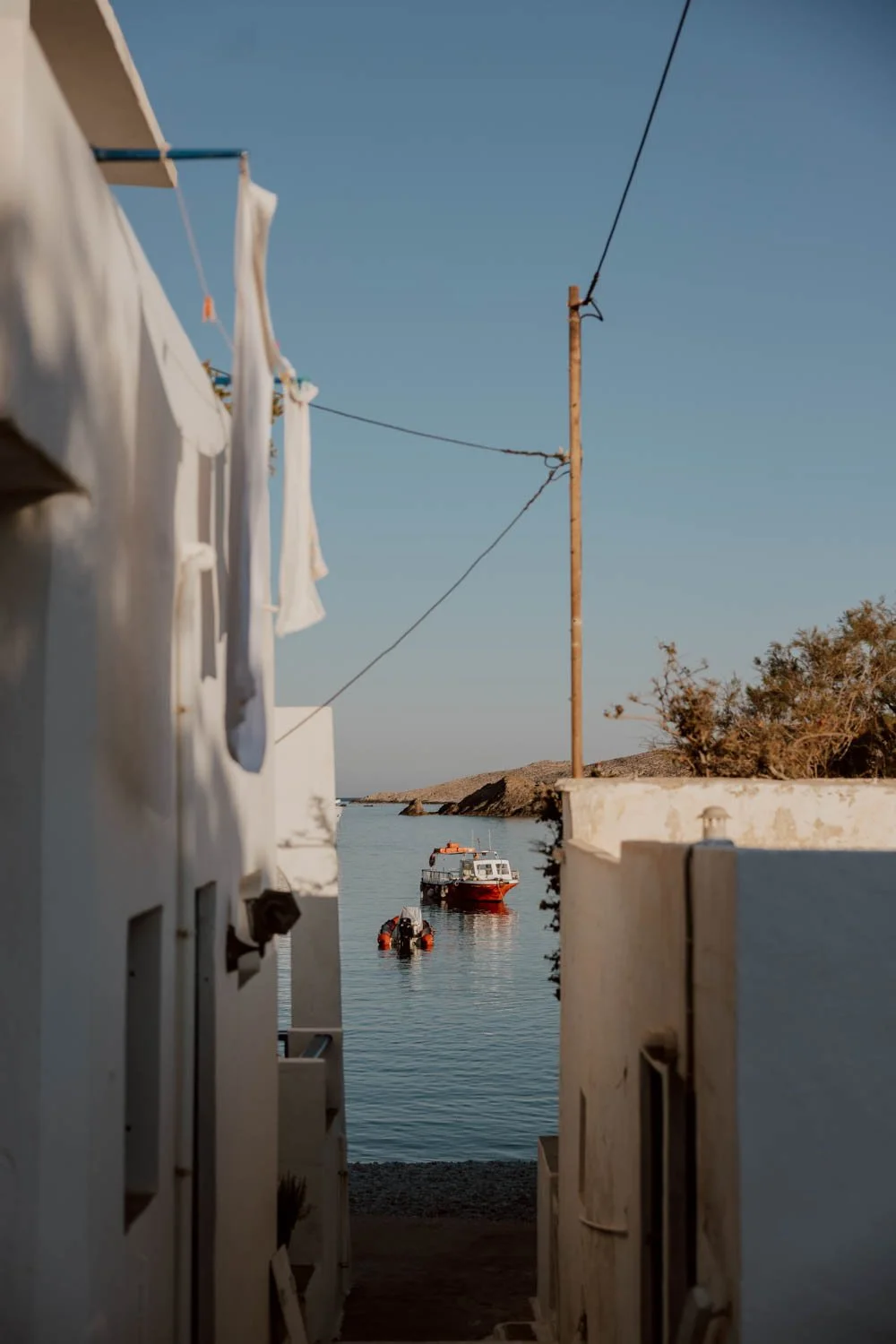
The port village is where the bulky ferries come and go, but it isn’t industrial or chaotic in any way. Indeed, with its gentle lapping waters, whitewashed houses, local gossip on Chochlidia beach, and handful of tavernas on the shore, Karavostasis has a pretty idyllic atmosphere most of the day.
It was our base on Folegandros: partly because we wanted to stay steps from a beach, and partly because we found this great Airbnb overlooking the water.
So, whilst there are advantages to staying down in Karavostasis, the better question is whether it’s worth you specifically visiting the port during your holiday?
On short visits of two or three days in Folegandros, probably not. But, for those staying longer and looking for an easy access, low-key lazy beach day with a more local soundtrack and a good selection of restaurants, shops, and cafes at hand, Karavostasis is definitely worthwhile.
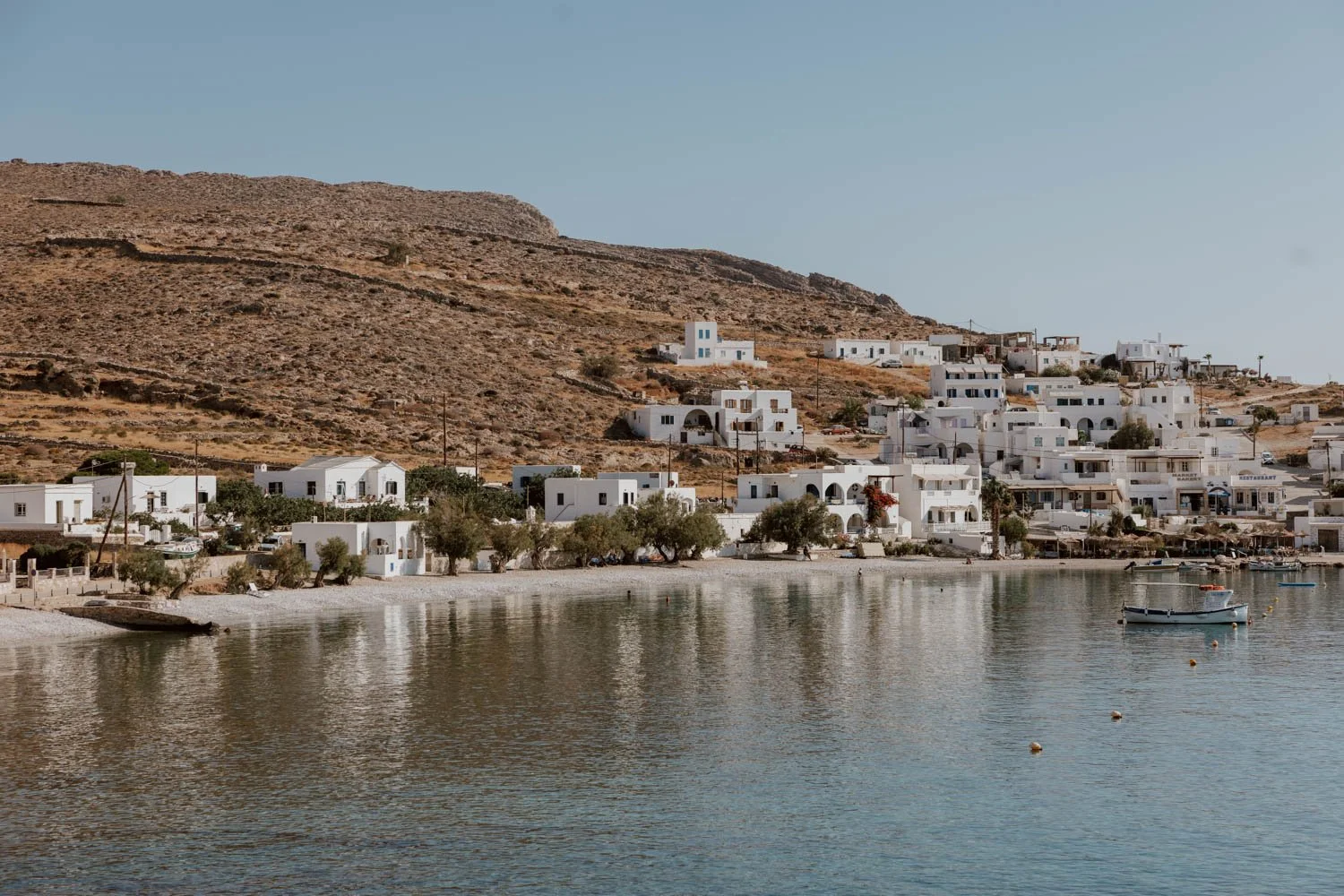
Beaches | Chochlidia beach is a local favourite for families, and it’s very accessible with parking close by (here on Google Maps). We stayed right by it, and it was where we’d enjoy an early morning dip or savour the last hour of sun before getting ready in the evening.
Tucked away round the other side of the port is Παραλία Βάρδι. It isn’t one to go out of your way to visit from elsewhere on the island, but it’s perfect if you’re staying here and just want a few hours on a good, quiet beach. From there, you can also just walk five minutes to several places Karavostasis for lunch or a beer. Note that it gets shaded from the left on the afternoon, and you should avoid it on days with strong northern winds. If driving, you can park up by the stairs. Find it here on Google Maps.
Eat | We were tempted in by the hand-written menu at Giannus and Maria’s beach restaurant, and the small plates and hospitality delivered in spades (maps). The little supermarket-cum-bakery is a bit expensive for some items, but their fresh biscuits and spinach pies became a daily treat for us (run by a really nice lady too). Sýrma does excellent espresso freddo! If you’re looking for a late-night beer, then Evangelos Bar on the beach is the best bet (Google Maps)
Note that it’s a lot quieter in the evenings down here than up in the Chora.
Know | There’s a dedicated bus between the port and Chora, with a first departure from Karavostasis at 8am and the last bus at 11.10pm (in 2025). Tickets cost €2 per person, paid to the driver on boarding. Find the latest schedule here.
Stay | We stayed in this Airbnb apartment, which was perfect for our needs. A big comfy bed, decent kitchen, rooftop, seaview, and occasional friendly cat visitor, we can happily recommend it for couples. If you’d prefer a hotel, don’t miss the design-led ANEMI. For more of our picks in Karavostasis, read our Where To Stay in Folegandros guide.
Explore The Island by ATV
Whilst the bus is perfect for reaching the main hubs, wholly depending on it will restrict where you can access on the island, especially on shorter stays.
This is why renting your own wheels is a really good idea - and a lot of fun too!
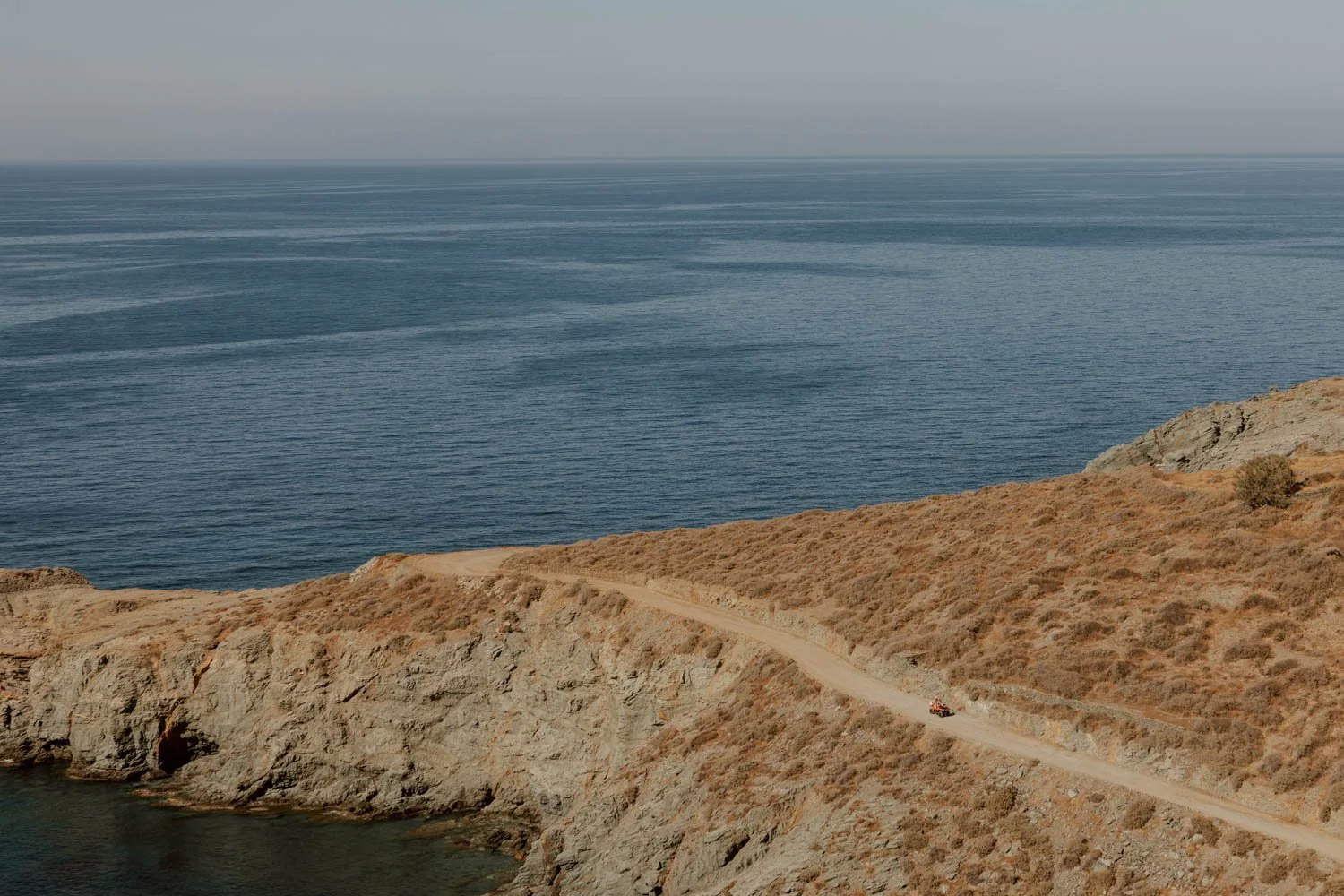
The rugged nature of the roads to several beaches on Folegandros makes a quad bike (ATV) the more sensible and stable option; unlike in Santorini, you also won’t feel like a total knob on one, as you actually require the power. The flexibility to roam allows you to experience more of the island each day and broadens your accommodation options beyond the main settlements. Distances are short too - it’s only around 30 minutes from the port to the end of the main road - so having your own vehicle doesn’t mean hours of driving.
We rented an ATV for four days but, if watching spend, you could get away with just one or two days if you want to concentrate your ‘exploration’ days to go beyond the bus routes.
We paid €40 per day at Spyros Rent-a-Moto in the port (maps) and can happily recommend them, but you’ll also find several companies in and around Chora. Price varies according to the size of the ATV. Cars are also available to rent.
Being responsible visitor and driver is essential, especially if you’re on the main roads in an ATV, and the locals ask everyone:
Don’t drink & drive
Take tight / sharp turns carefully
Don’t drive fast - and go slow in areas where children play
Park only in designated areas
Stay off your phone when driving
Be sensible on dirt roads
Know | You’ll require a driving licence and possibly a credit card for deposits. Make sure to wear your helmet, and remember that travel insurance usually doesn’t cover scooters or ATVs abroad unless you hold the appropriate licence in your home country.
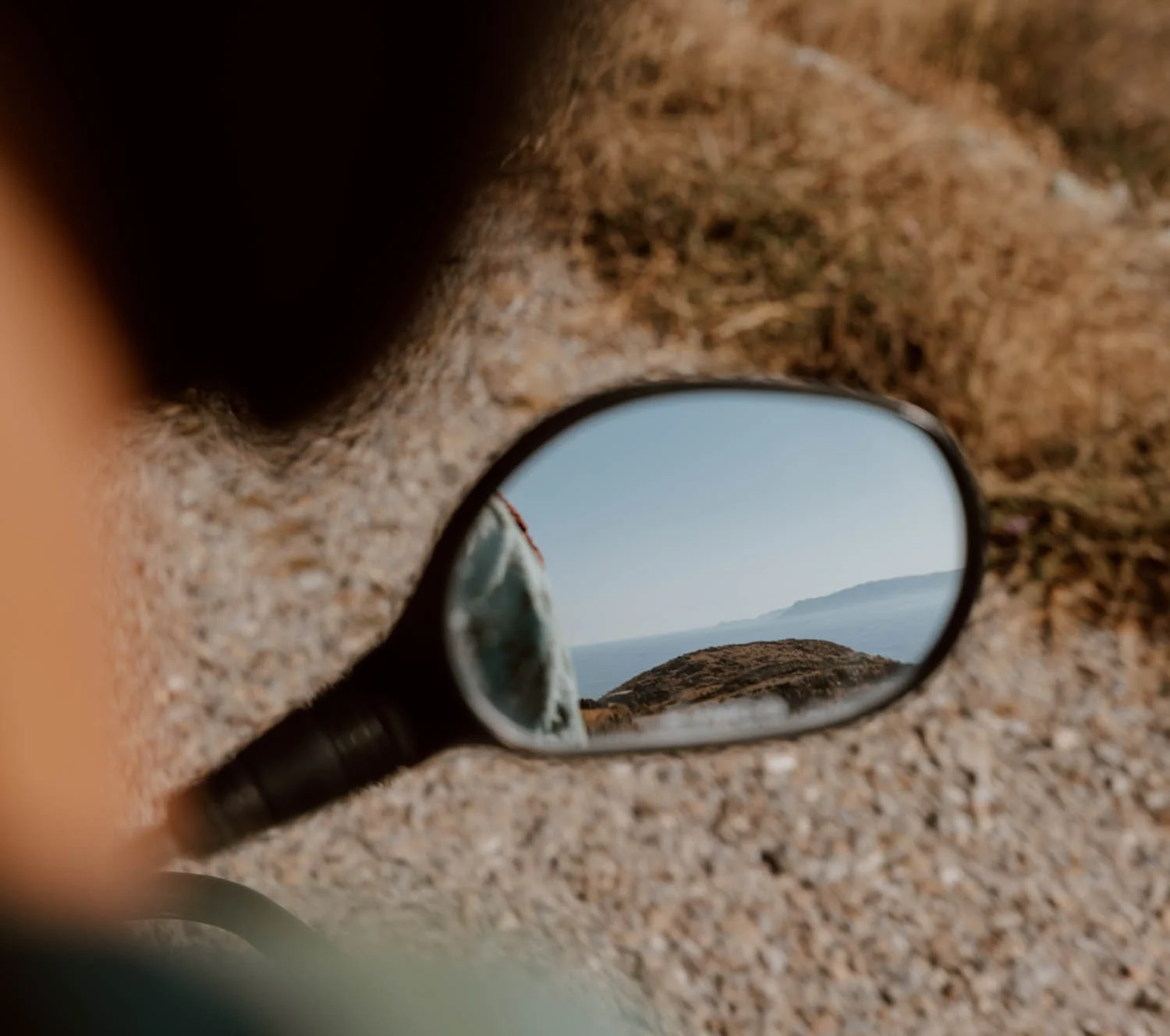
Paralia Ampeli & Food at Spina Osteria
A secret rocky enclave on the northwest of Folegandros, it’s all sorts of wonderful down here.
As you’ll be expecting by now, the descent to the sea involves another very dusty, steep, rock-marked ochre road that’s best done with four-wheels and confidence. The reward is a place that only locals and those in-the-know will make an intentional beeline for on their day off, and it reminded us of so many of the sort of calas and cale we’ve learned to love in Spain and Italy.
Perfect water, perfect swimming.
If you need sand or detest lying down on stones or rock though, then Paralia Ampeli won’t be to your tastes.
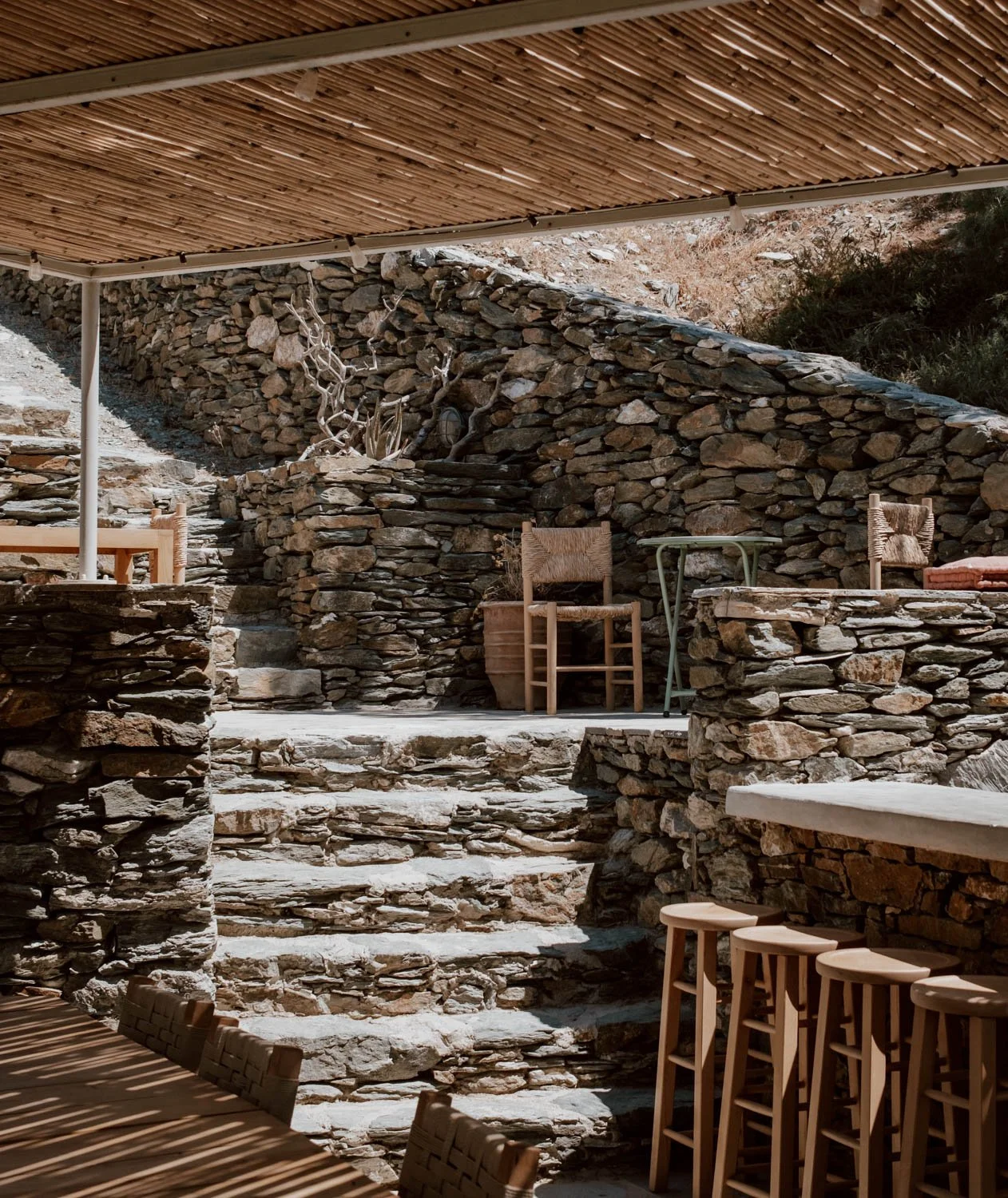
The presence of Spina may however offer additional temptation: a relatively new addition to the island, it has a fantastic open-air sea-view setting a short walk above Paralia Ampeli and their small restaurant prioritises local, small-scale, hand-picked and caught food (often with an Italian spin). We didn’t know about it until we arrived at Amepli, so only had a couple of coffees and chat with the team, but it’s possibly the sort of place that’s worth going out of your way for.
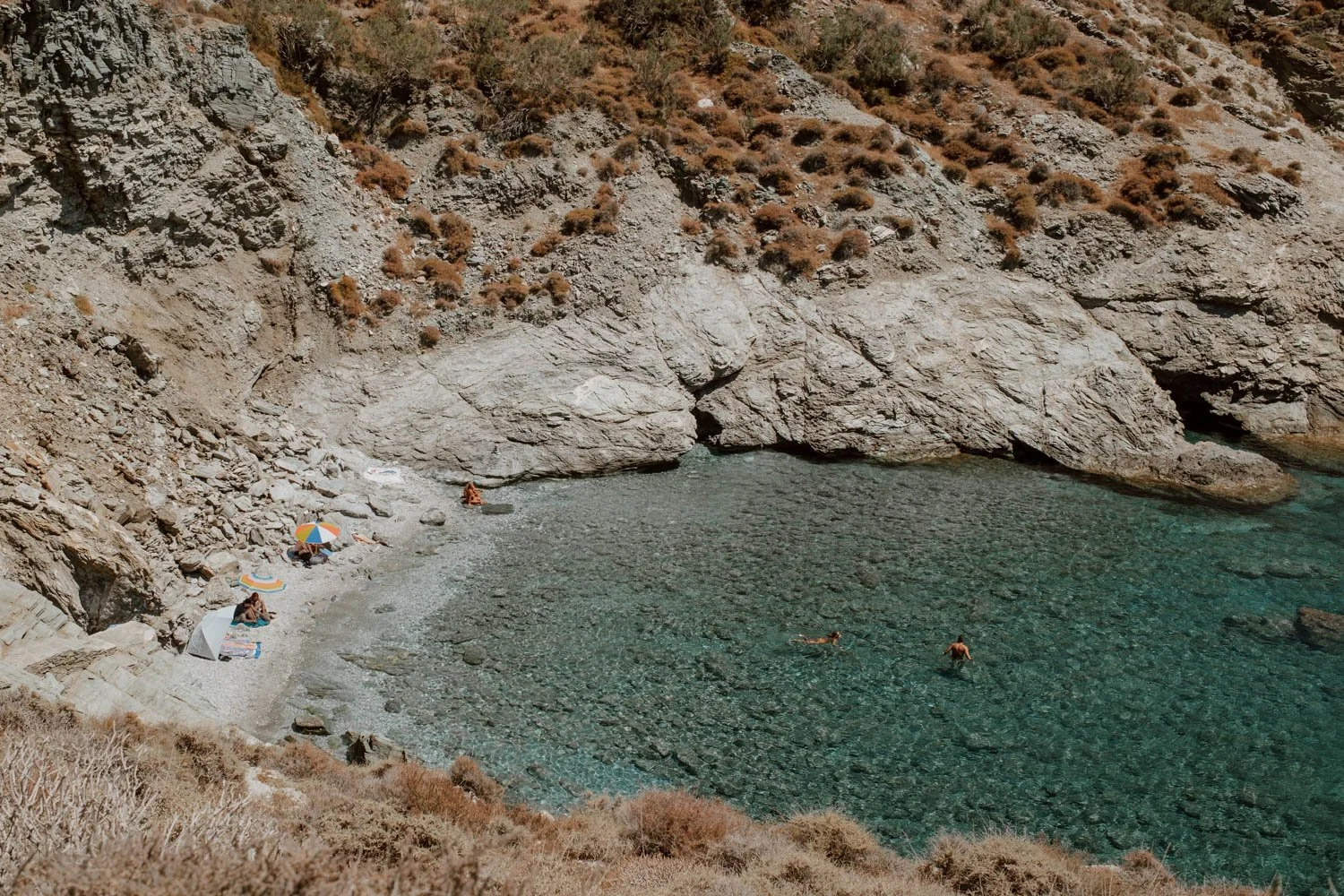
Where | On the lesser-visited northwest of Folegandros, you can find Paralia Ampeli here on Google Maps.
Go | It’s a rough ride and road, so we were really glad we headed over with our quad bike. Whilst it is possible on a scooter - as evidenced by a handsome oh so Greek guy we saw navigating it with a beautiful female passenger and his takeaway frappe in one hand - it’s probably not a good idea for those who have no or little experience riding. It’s the sort of road and descent you could easily dump on, and we’d hate for any injuries or accidents to ruin your day.
A piece of advice if you’ve got an ATV or car - there’s an area at the top of the hill which looks like it’s where you should park, but make sure you continue right down to the bottom where you’ll find a small car park area. From there, it’s a very short walk to the beach.
There is also a hiking trail to Ampeli, and you can find the start point here on Google Maps. This is just up the road from the Lividaki hike startpoint, and the sign said it takes thirty minutes one-way.
Bring | Everything you need for the beach. There are small patches of sand/pebble, but you should expect to be lying down on rock - and it can take a bit of time to find a comfortable spot! Nudist-friendly. If you’re on the beach, you can simply walk up to La Spina for coffee, lunch, food etc.
Know | The Spina Osteria is only open from 1st May and bookings are highly recommended for its evening sittings.
Stay | Spina has a few rooms, whilst there are also a couple of beautiful villas nearby: Green Luxury Villa and this luxurious three-bed villa.
A Boat Trip Around Folegandros
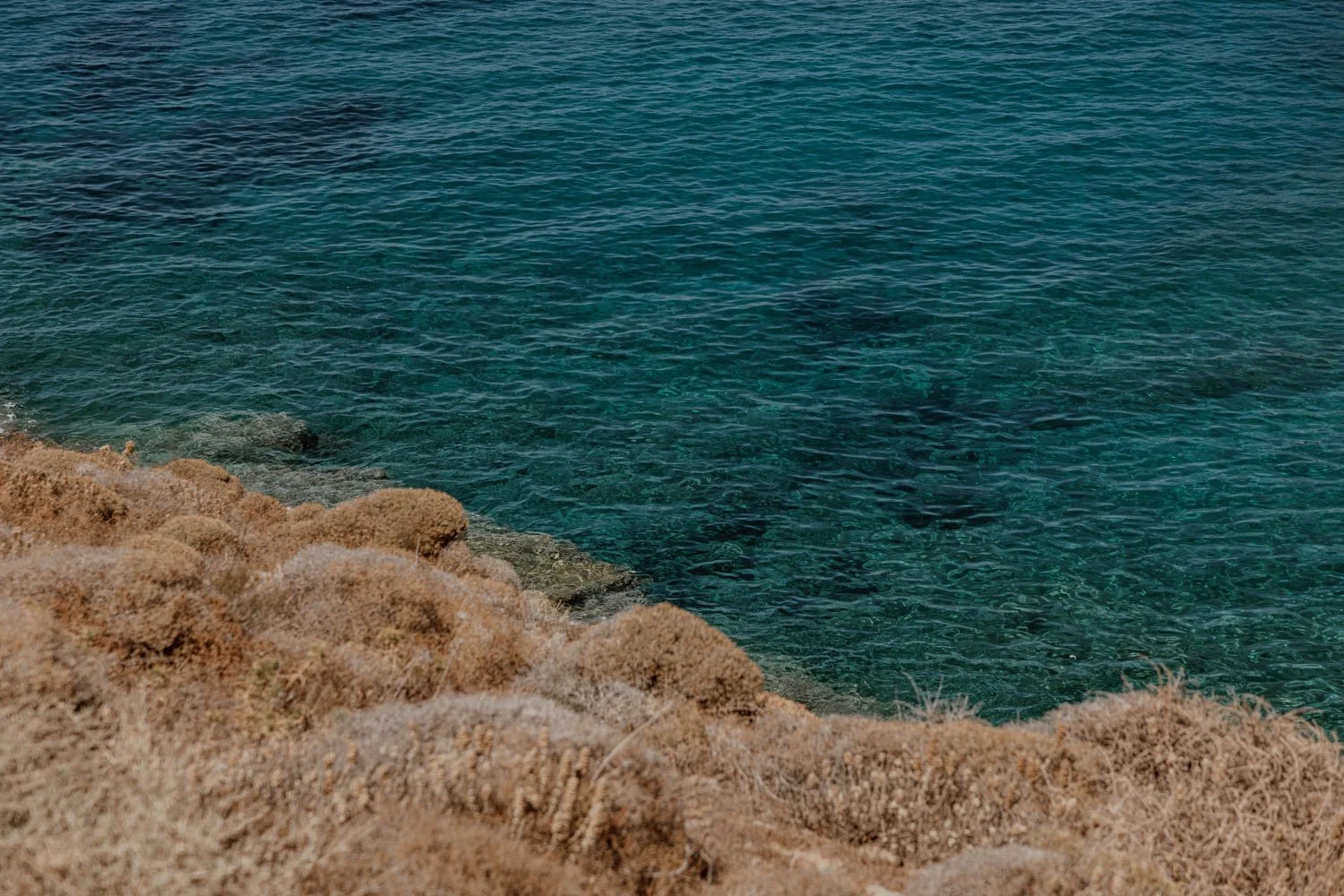
Those with less time on the island or no inclination to rent an ATV, should consider heading out with a boat tour.
A range of local operators exist, and they all appear to offer a roughly similar sort of experience and route. The focus is on secluded beaches and bays, swimming stops, snorkelling, and a light lunch. A few examples:
· The Stella Express II tour costs €50 per person, runs from 11am-4.45pm.
· Sottovento runs a half-day tour from €40 per person, or €60 for a full-day seven hour tour with a late-morning departure
· Island Spirit offers a four-hour tour of the south or north coast, starting at 10am
Note that these can also be done as private excursions, and the final itinerary always depends on the wind and sea conditions. It’s a good idea to confirm overall group size too.
Alternatively, if you’d prefer land-based experience that focuses on the history, culture, and traditions of Folegandros, then consider booking a spot on this highly-rated walking tour.
Drive to Agios Georgios Beach
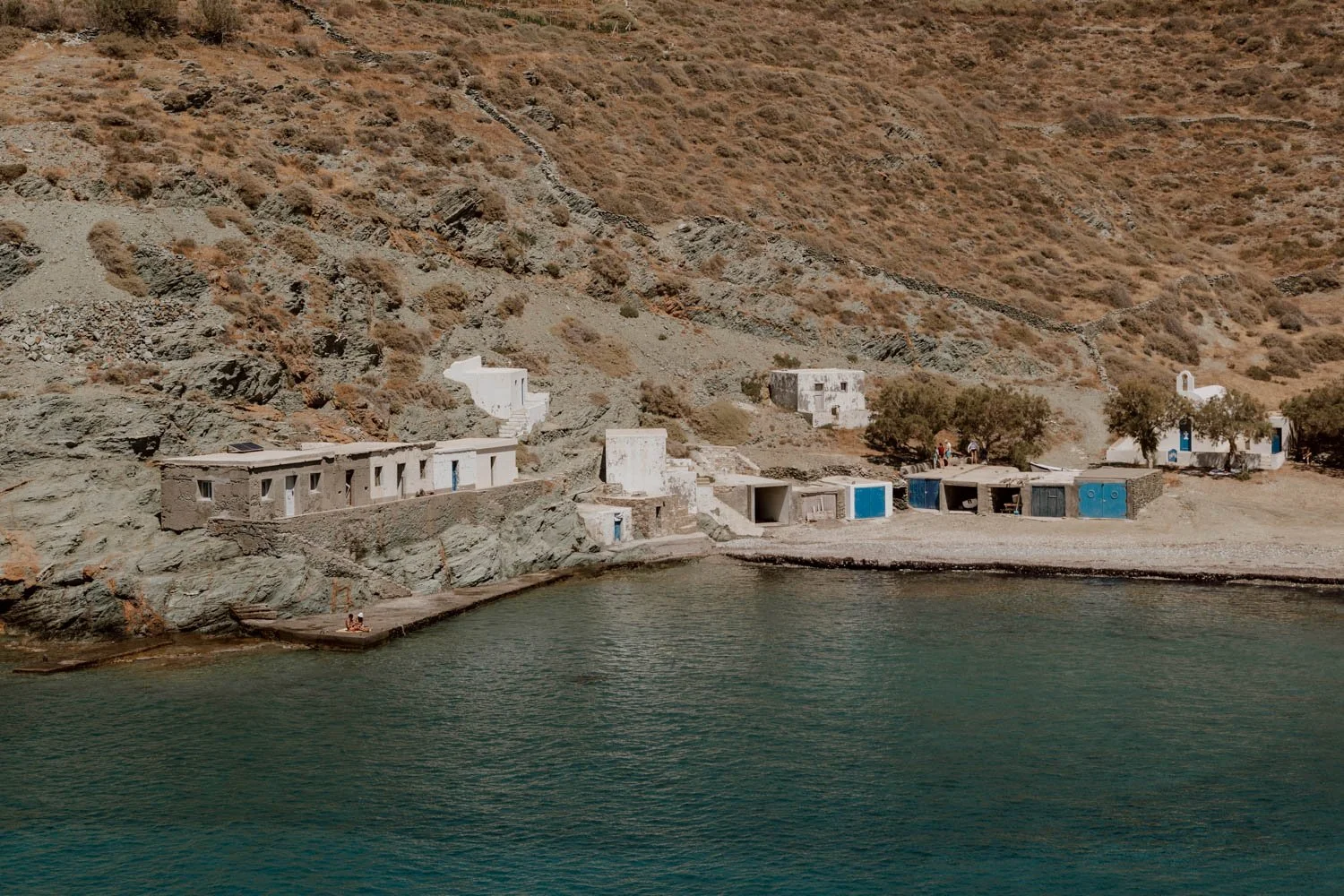
We adored this remote old fishing harbour on the northern tip of the island, but we’re fully aware it may not be everyone’s favourite.
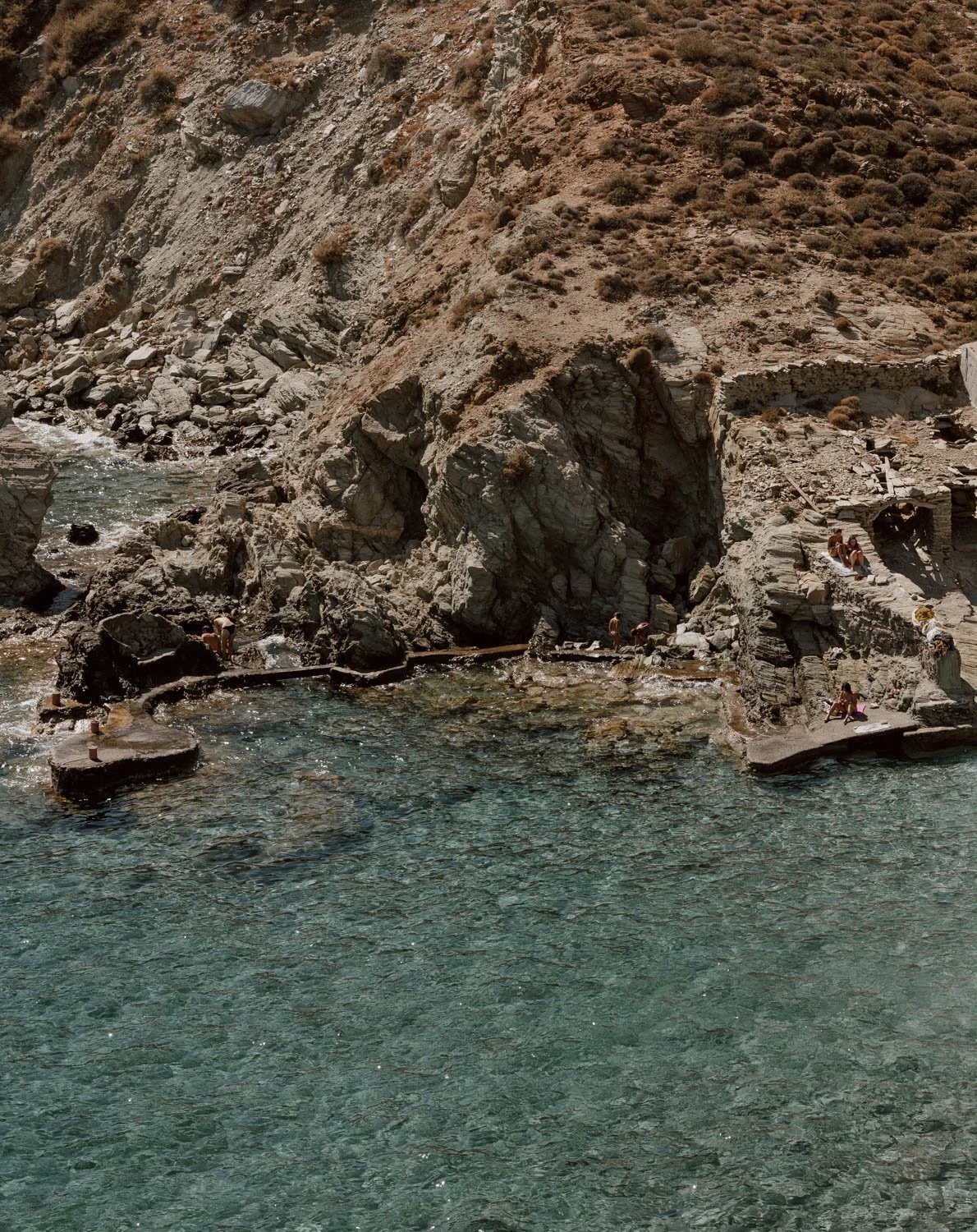
The beach, mostly scrub stone, seaweed, and dark shingle sand, is not that pretty on neither first sight nor second impression. It’s also not particularly pleasant feeling to sit on. There’s a cluster of abandoned fishermen’s dwellings and huts, mostly skeletons of concrete, peeling blue paint, and disappeared windows, whilst the to make it there is ever so slightly treacherous.
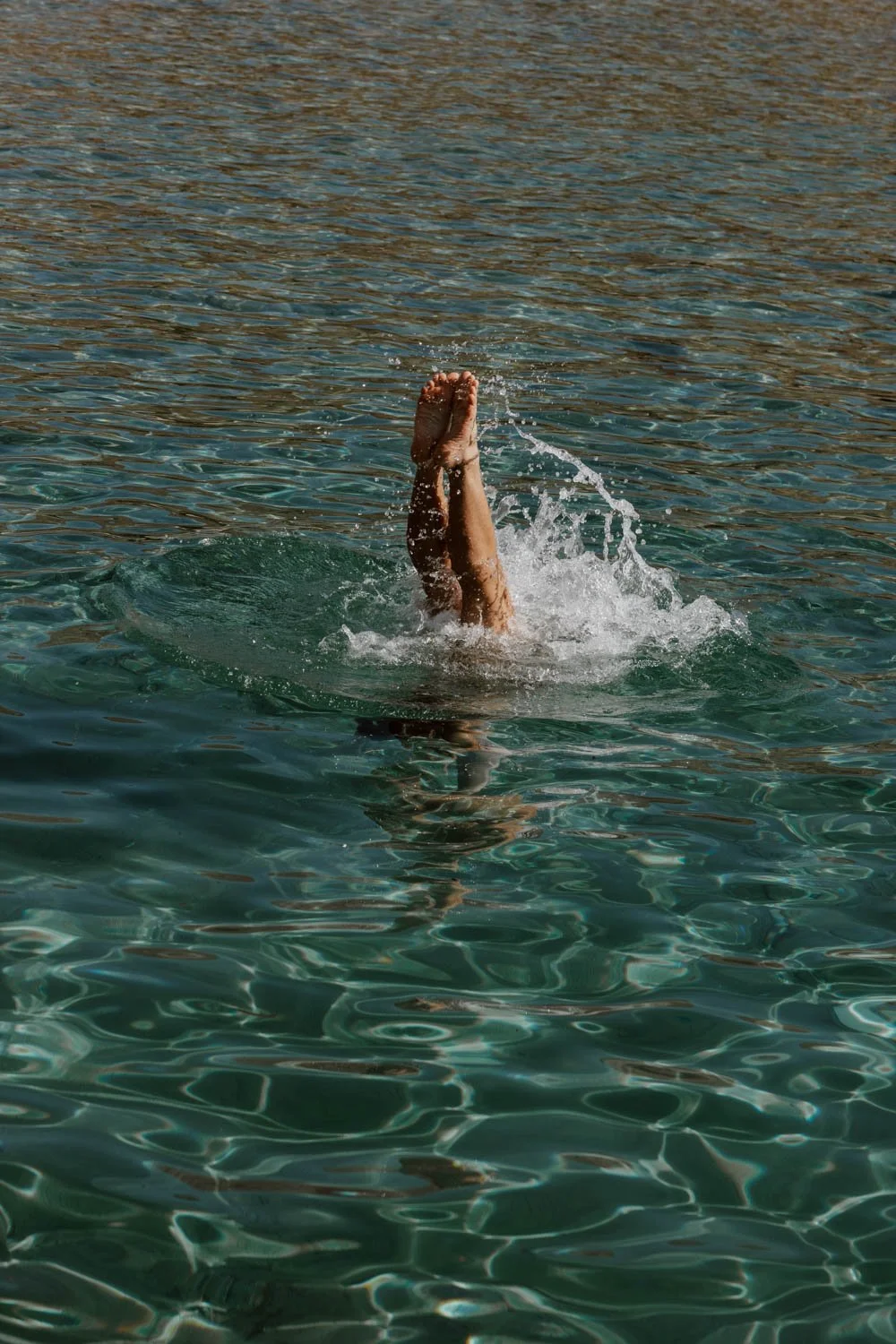
The water though, is flat and calm like a pool, and sparkles with diamond glints. The swimming is amazing, and one can plunge far below. There are no boat taxis dumping twenty or thirty people at once, so it’s only populated by travellers who have made the effort.
And, for those who have spent many a summer in Italy, there is the most divine concrete platform to spread out upon and dive deep.
European. Summer. Perfection.
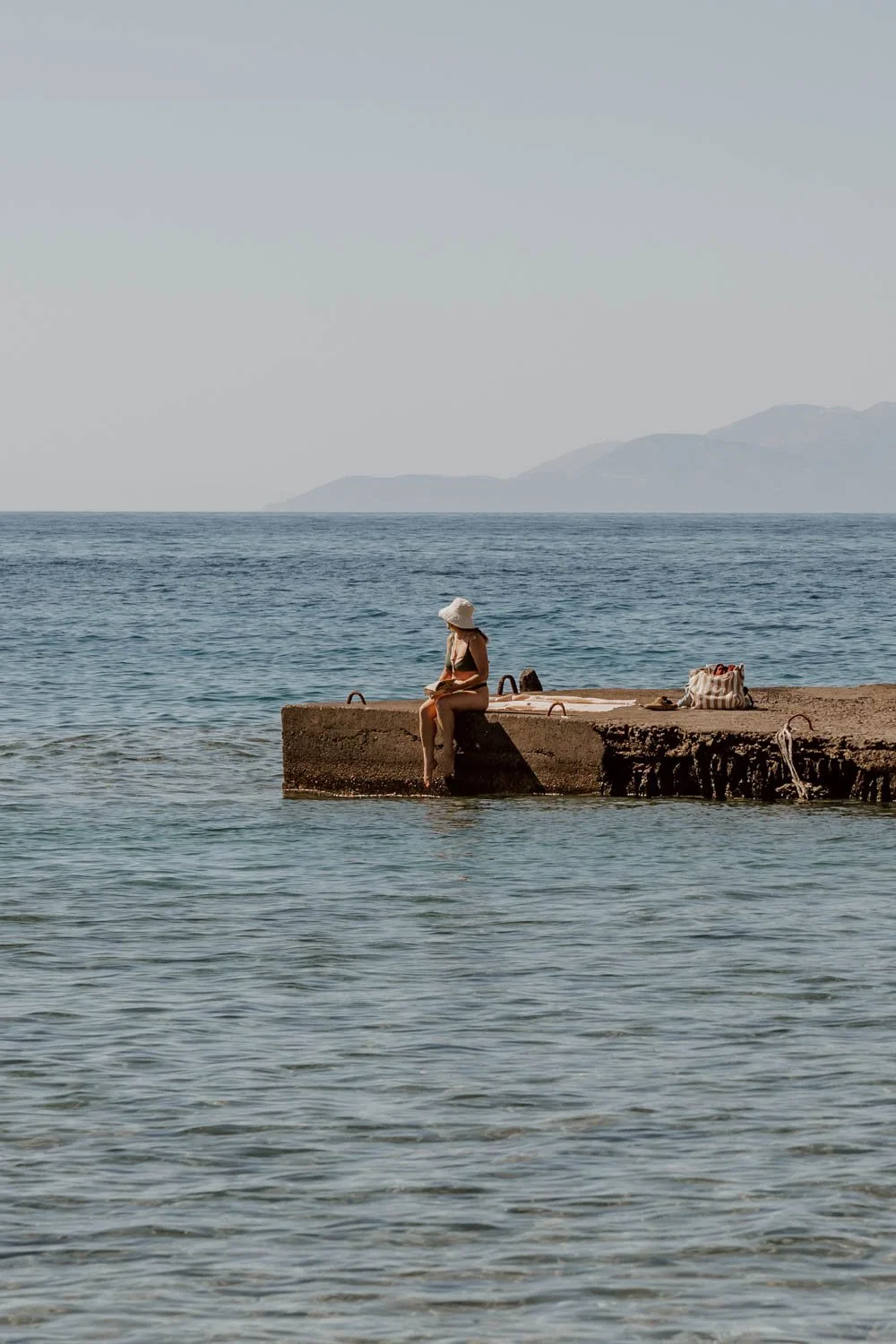
Where | You can find Agios Georgios beach here on Google Maps. Given their proximity and the fact you’ll need a scooter or ATV to reach them both, t’s a good idea to pair it with Paralia Ampeli.
Reach / How | You have two options:
- Rent a quad or car to get there. After the turn-off and paved section, the road becomes an ochre-coloured dirt track with steep ups and downs. An Italian couple made it on a scooter, but he clearly knew what he was doing; inexperienced riders will likely find it stressful, and there’s a real risk of tipping over. Much more fun and stable on an ATV! There’s plenty of space to park behind Agios Georgios beach; try to grab a spot under a tree for shade.
- You can also reach Agios Georgios via hiking trail #3, with a suggested walking time of 50 minutes from Ano Meria.
Bring | There’s nothing around, so bring everything with you. The only thing that’s missing is an enterprising individual with a cooler of cold beers for sale. Nudist-friendly.
Know | Paralia Ligaria is the beach you’ll actually come across first as your drive down the hill (maps). A smaller pebble/dark sand cove, it’s also lovely and remote but we much preferred Agios Georgios, so recommend you keep driving on.
Insider Tip // Whilst it doesn’t make the cut for our best things to do in Folegandros, if Agios Georgios and Ampeli sound like your kind of place, then the secluded Paralia Vorina (map) should be on your radar. It’s a short drive outside the Chora but require a 20-minute walk down a steep, overgrown shingle and gravel goat trail. The beach is mostly shingle, rock, and fishing equipment detritus, but it is a big, beautiful shallow swimming area and only attracts handfuls of people. Some will adore it, but others wouldn't put it in their top five - especially as it’s a 40-minute round-trip on foot! Only go when the northern winds aren’t blowing as it’s very exposed to them - and this is one to have in your back pocket if the southern winds are strong! For the trail, there’s a small area of parking at the roadside by the little church above the abandoned hotel - here on Google Maps.
Where to Stay in Folegandros | The Highlights
We were super happy with our choice of base at the port, but we know that won't be best for everyone, particularly those who may be on shorter stays. The Chora - at the top of a hill but actually much more accessible, easy to navigate, park, and walk around than several in the Cyclades - is absolutely going to be the best choice for many. You’ll have everything right on your doorstep for food and drink, the buses go from there to the port and elsewhere, and your vantage point means sweeping sea views are the norm.
Next, staying on the area we’ve called ‘the spine’ of the island is actually a brilliant idea. This includes the village of Ano Meria, as well as the places you’ll find before and after along the main road. We considered it during our research as there were several gorgeous properties, but our main concern was that we'd feel too removed and not have options for eating out in the morning or evening if we didn’t feel like going into Chora. The reality on the ground was quite different though, so if you prefer to have just local local options and fewer tourists on your doorstop in the evenings, then somewhere along the spine could be a masterstroke.
Whether you’re going to rent an ATV, scooter, or car may also play a role in your final decision.
We’ve shared several our picks in those three ‘hubs’, but you can find much more advice on choosing the right base and more options to suit every travel style in our dedicated Where To Stay in Folegandros post.
The Chora
Avaton | One of the newest additions to Chora’s hotel scene - and arguably its most luxurious - Avaton sits just before the village entrance, close enough to walk into the centre within minutes yet slightly removed from the evening foot traffic. Rooms are generously proportioned, modern and meticulously maintained, with large balconies framing wide island and sea views that quickly become the stay’s defining feature. The pool area feels considered rather than crowded, surrounded by open landscape and designed for long, unhurried afternoons.
Chora Resort Hotel & Spa | A great option for those that want all the benefits of a resort but a location in the heart of the Chora, this is a longtime popular option. Whilst offering all modern amenities, the rooms lean a little more traditional than we’d like, but if you value facilities and location over contemporary design, this may be perfect.
Cottage House | This recently renovated traditional themonia is just a ten-minute walk from the centre of Chora, but in a super quiet location with magnificent panoramic views over the village, the iconic Church of Panagia, and the neighbouring islands from the private patio. It doesn’t have a full kitchen or wifi but the interiors and location more than make up for it.
Little Cellar | If you’re a couple looking for a unique stay in the centre of Chora, this super traditional house may perfect for you,
Cliffhouse | An 800-year-old Venetian townhouse set within Chora’s Kastro, this two-storey stone home pairs thick original walls and careful restoration with rare cliff-edge views from not one but two verandas overlooking the Aegean. The interiors are beautiful with considered touches making this a firm favourite in this part of Folegandros!
Agali
Perigiali Family Apartment | This two-bedroom apartment is simply stunning, with contemporary design and interiors that go far beyond much of what is offered in Agali. Every element, both inside and out, is thoughtful and considered, with two terraces offering uninterrupted views of the sea.
Theros Apartment | It’s quite small inside but super stylish and the terrace is huge and literally on the beach.
Blue Sand Boutique Hotel | Agali’s premier hotel offering, Blue Sands is perfectly positioned overlooking the beach and sea beyond, with direct access to the sand. We’d class the design throughout as ‘modern Cycladic’, with spacious rooms all offering private balconies. The perfect holiday escape!
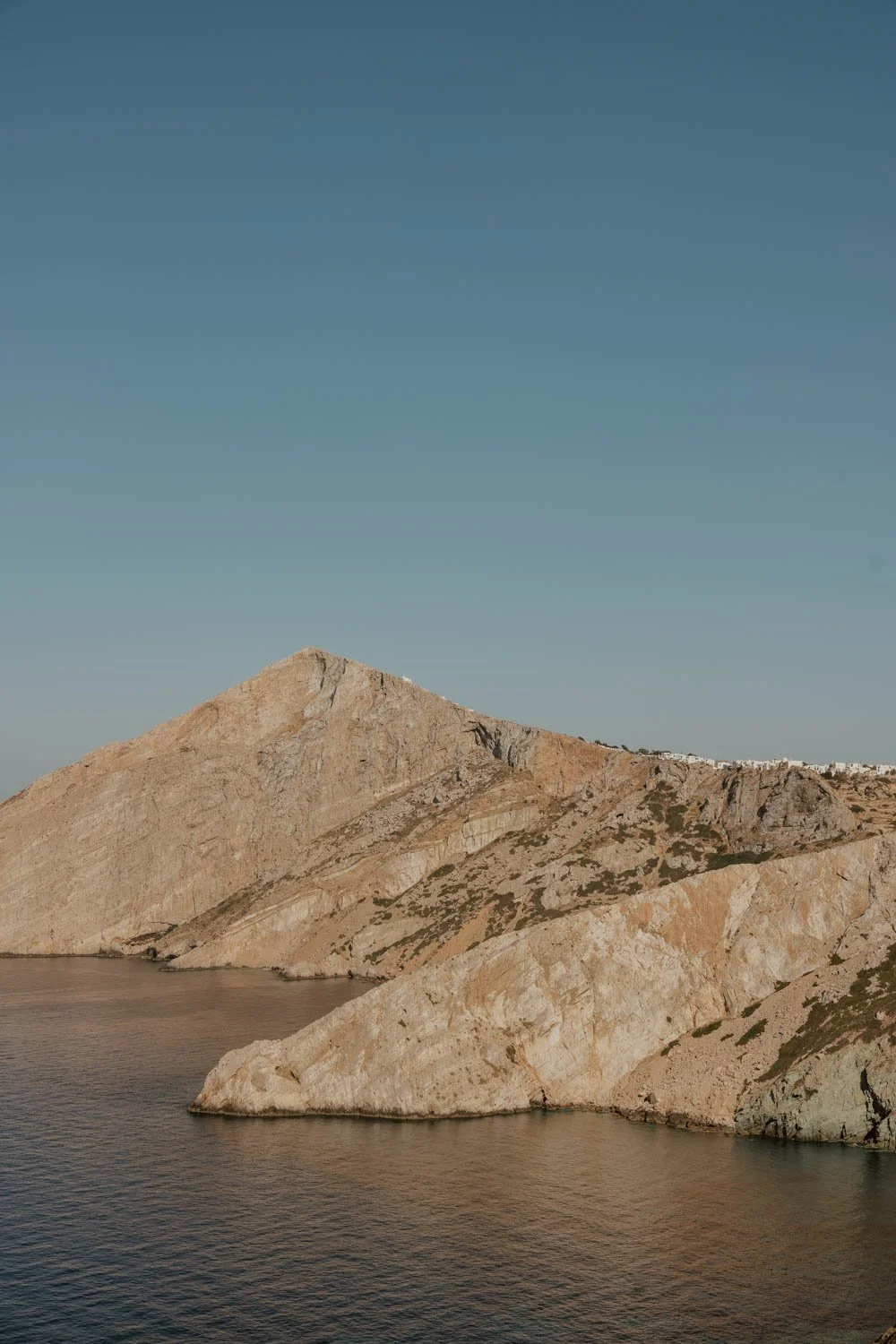
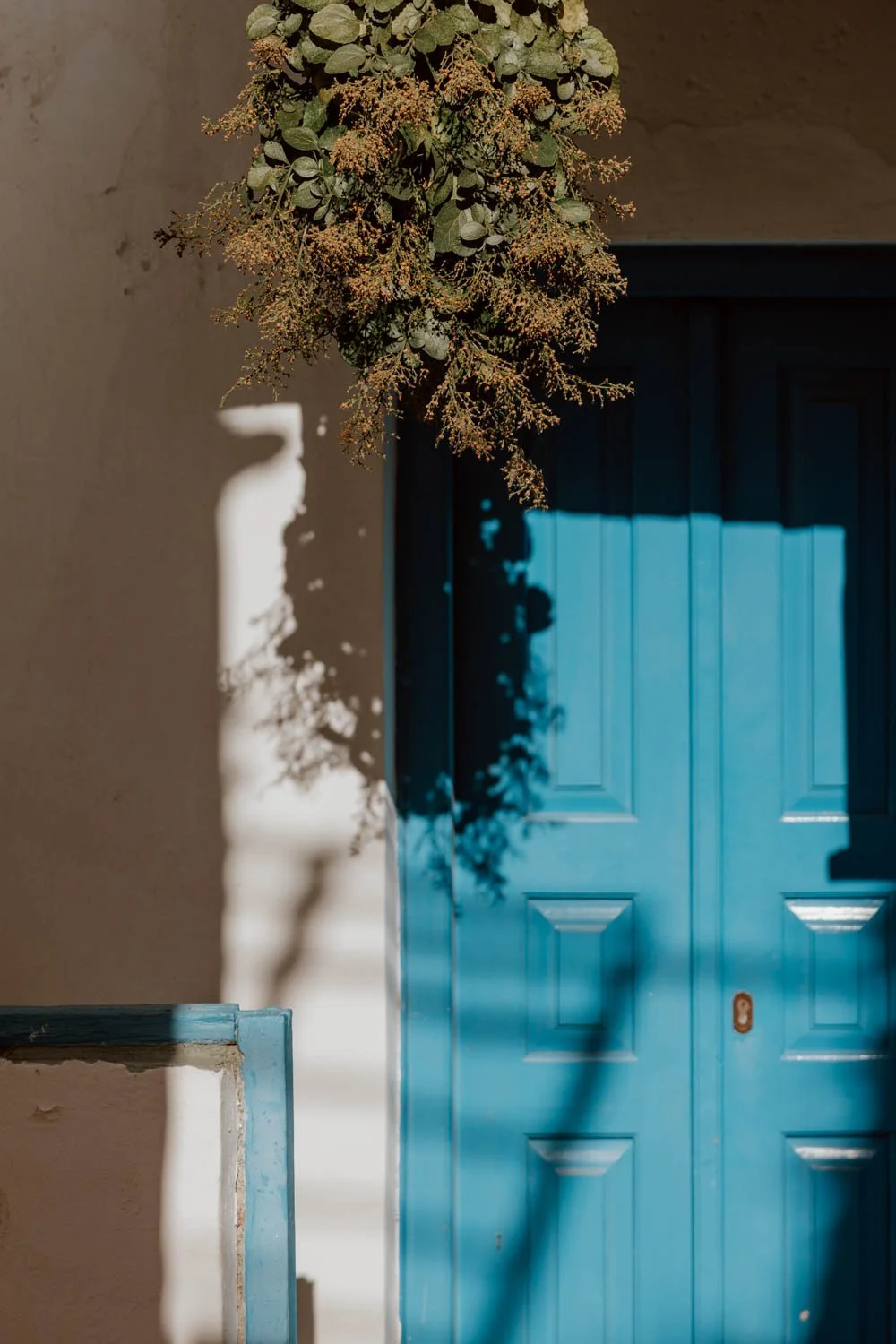
Karavostasis (The Port)
ANEMI | Located a couple of minutes walk from the seafront, this luxurious, design-led hotel embodies ‘the perfect fusion of new-age aesthetics and Greek finesse’, and is by far the fanciest place to stay in Karavostasi. For those that wish to be more active, it also offers an excellent outdoor gym, tennis court, pool and spa.
Vrahos Boutique Hotel | Built into the rocky slope above Karavostasi, Vrahos holds one of the bay’s strongest positions - elevated enough for wide sea views, yet only a short walk from the water. Rooms range from simple doubles to split-level suites, most with balconies angled toward the harbour, and while the interiors are clean and contemporary, it’s the outdoor space that many guests really appreciate: terraces that catch the light and breakfast served looking straight across the bay.
Beachfront Cycladic House | This lovely little one-bedroom apartment is where we stayed, and honestly, it was fantastic. It’s is literally on the beach and steps from the water, has a huge bedroom, a small but well-equipped kitchen and whilst the living area is pretty small, in the Greek summer, it’s more than made up for by the balcony overlooking the water and the roof terrace which is perfect for golden hour aperitivos!
The Spine & Ano Meria
Gundari | Open for less than two years, this is Folegandros’ first five star hotel and it is simply breathtaking. Set atop rugged cliffs with spectacular views overlooking the Aegean, the design is flawless - a mix of elevated minimalism and raw luxury in a earthy palette that beautifully complements that natural environment. All rooms have small private pool areas, but there’s also a shared pool area with views out over the water beyond, a spa, and restaurant (with Michelin Star chef). Undeniably worth the splurge.
Maistros | Located in an isolated cliff-edge spot around a 15 minute walk north of Chora, we would stay at this excellent little house in a heartbeat. The interiors are simple but the windows large and angled toward the Aegean, and a terrace upon which we could easily spend dawn to dusk.
Agada | One of the pricier options one-bedroom options in this section, this relatively open-plan suite offers a real taste of luxury. Light-bright and beautiful interiors give way to an expansive terrace with pool and never-ending views across the water.
Venue Villas-Afrodite | Small, but perfectly formed, this one-bedroom stone-built hideaway feels made for two. Traditional Cycladic walls anchor the space, while the interiors lean contemporary and restrained, letting texture and light do the work rather than decoration. Outside, a compact terrace looks out across open island landscape to the sea, with a plunge pool positioned for long, unhurried afternoons and quiet sunset drinks.
The Big Mill | Set amongst the island’s old windmills, this generational family home enjoys wide sea views in both directions, from both the house and its two terraces. Lovingly maintained and full of traditional character, it feels like a real home rather than a rental - simple, warm and quietly special - with Chora a 15-minute walk away and a footpath to a small beach directly below.
If you need more space, take a look at this stunning four bedroom property with a private pool overlooking the Aegean Sea, this luxurious three-bedroom, architect-designed luxury villa or Themonia to Taximi, a beautifully renovated one level house set amongst mediterranean gardens
Plan // Find more advice to help you choose in the Where To Stay in Folegandros guide
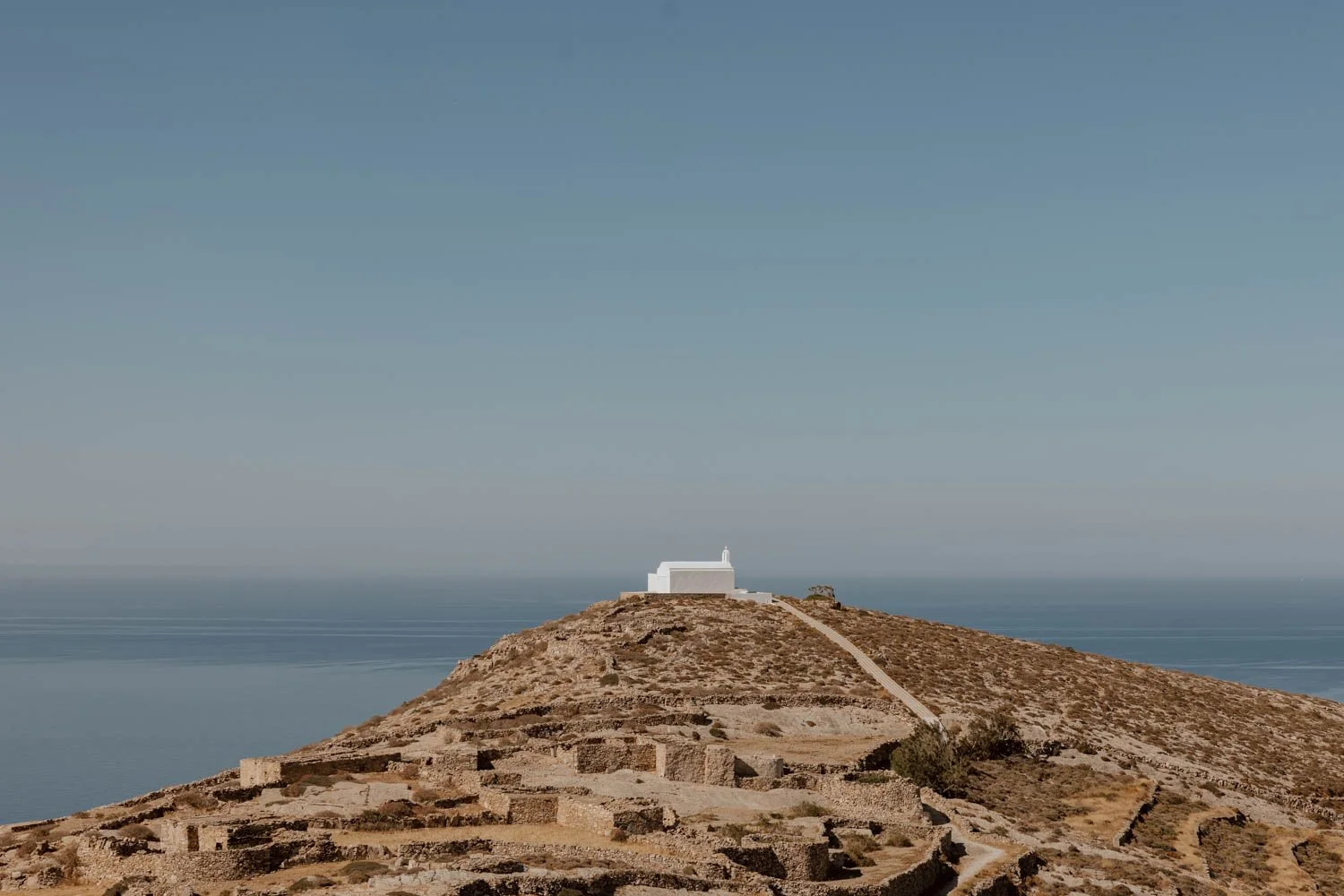
Where To Eat & Drink in Folegandros
As promised, these are the places we personally enjoyed or can recommend seeking out on the island. Word to the wise, the Greek schedules eats late and drinks even later, so don’t be one of those tourists who fails to get into the rhythm.
The Chora
Eva’s Garden - simply one of the best meals we’ve had in Greece. Reservations are recommended in peak summer (map)
To Spitiko - this family restaurant offers a super traditional but refined menu, with a hidden outdoor dining area. This is where Andrew opted to try a Folegandros favourite of matsata, a local variety of fresh tagliatelle-like homemade pasta with rabbit and a tomato sauce (map)
Restaurant Piatsa – in the main square, a solid option for meze dinner if you can’t decide. Nothing flashy, but dependable (map)
To Barbounaki – a long-established favourite for seafood-focused meals (map)
Prickly Pear - the place for bright, healthy breakfast bowls (map)
Lotzia – a lovely little café under the tree canopy, it’s a good spot for a breather (map)
ParasAgas – the obligatory gelato stop (map)
KYKΛOS – tucked away on a quiet street, it’s perfect for a spritz or cocktail but hey also serve breakfast (map)
Astarti Bar – cool raki bar in the square, open until 3 am (map)
Aquarius – old-school rock bar with Led Zeppelin and AC/DC on the tables, decades of history, and fag packets on the walls.
BaRaki – down the ‘cocktail alley’, it’s a cool spot by the church with cats, good classic cocktails, and a quieter vibe than the main square. A good pick if you’ want to keep going after dinner (map)
Laoumi Music Bar – hidden away, only found if you’re looking. Unique space, great music, excellent cocktails (map)
There are also several options in the centre for big meat eaters and if you just want a cheap but tasty souvlaki.
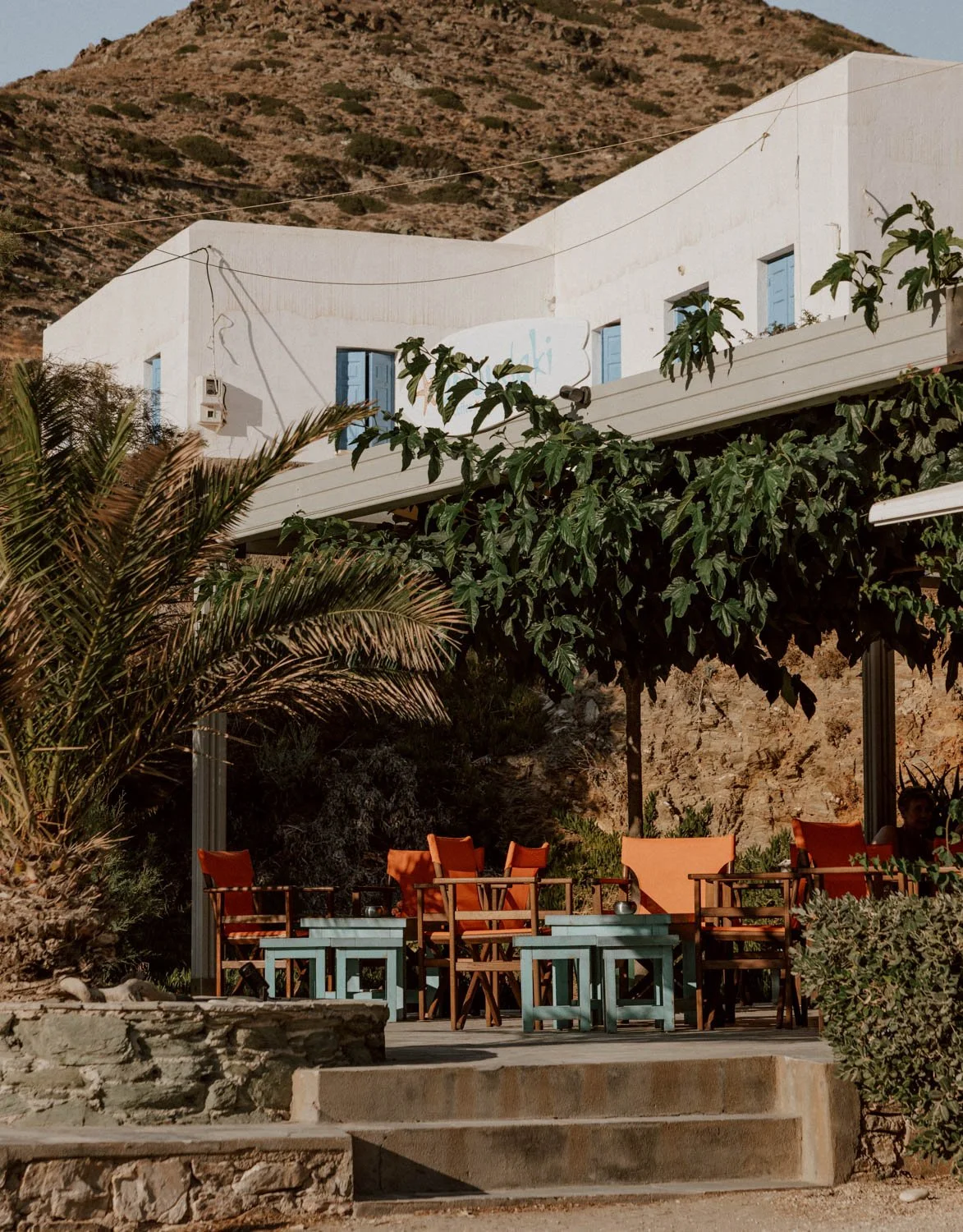
The Spine & Ano Maria
Under The Palm Tree | A very modern menu and set-up, it’s a great shout for brunch and the coffee was excellent. We didn’t visit in the evening, but it switches to being all about cocktails and beers, and we imagine it’s pretty good - map
Irini's Tavern & Grocery Store | This family-run minimarket-cum-taverna in Ano Meria offers a truly authentic, home-cooked experience, with no formal menu, generous portions, and classic island dishes prepared the old-fashioned way - map
Chrisospilia | A charming little café known for its fresh homemade breakfasts, pastries, crepes, and warm hospitality. Also has a really nice lunch menu - map
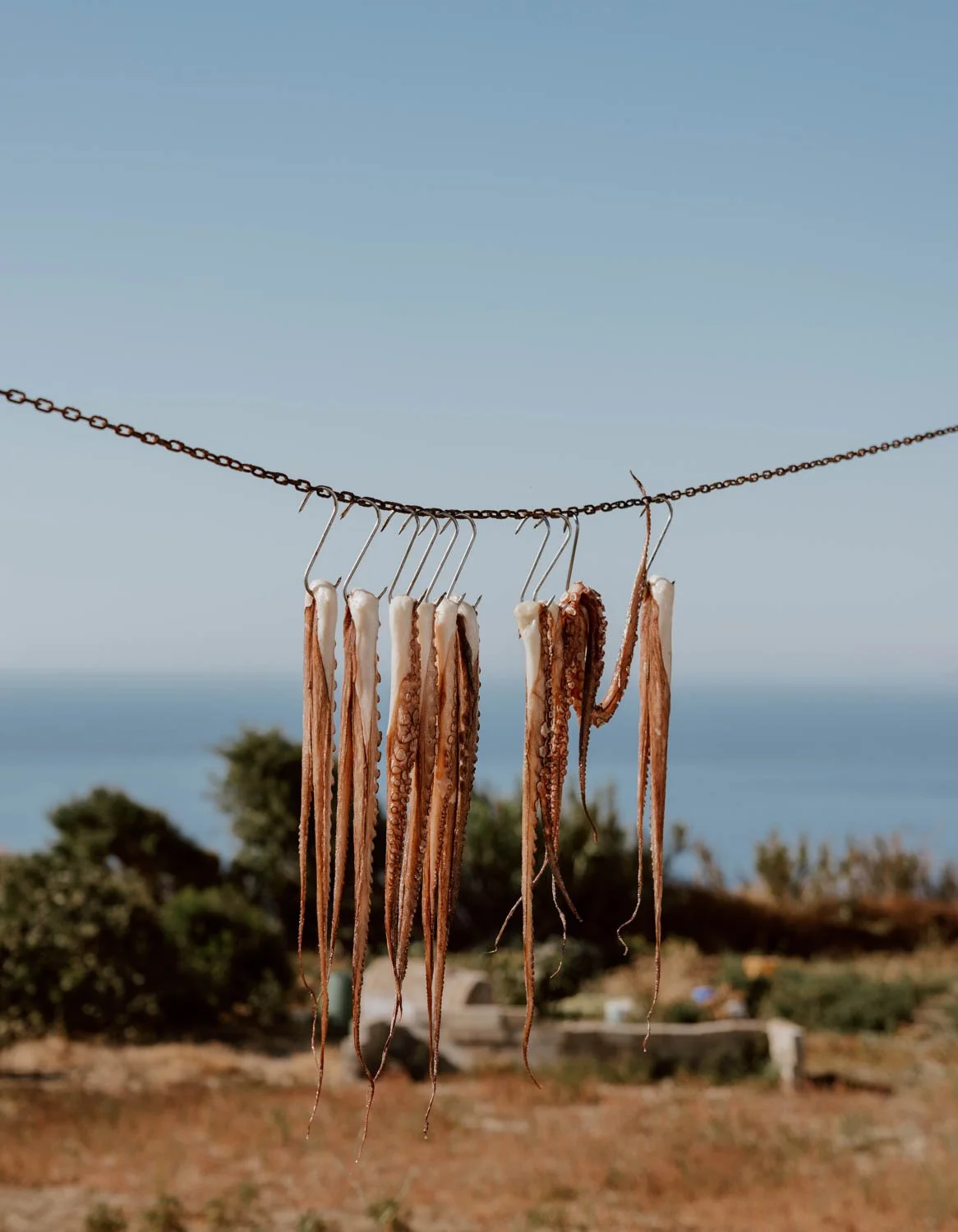
Ristorante Flora Mimis | We include solely because we always saw fresh tentacles hung out to dry in the sun and wind, so it felt like the marker of somewhere that would be seriously serious about certain dishes. Traditional, local fare, serving dinner only - map
Travel Tip // Whenever on a Greek island, make a point of frequenting any bakery you pass! One of us became slightly addicted to slabs of kalasouna (the souroto cheese and onion Folegandros pie), which became our go-to snack to take to the beaches. Also, it’s a good thing to develop a freddo espresso habit, the Greek version of iced coffee which you’ll see every local slurping and sipping on.
How To Get Around Folegandros
Buses
Folegandros has a decent public transport network, and almost everyone will use it at some point. There are three buses:
Port - Chora | This runs everyone up and down the hill in 10-15 minutes, from around 7.50am until midnight | €2 pp
Chora - Ano Meria | Less frequent, this service runs along the main road between the town and village | €2.50 pp
Chora - Agali | Operated by Agali Travel, this runs from Chora to Agali beach 10 minutes | €2.50 pp
You can find current schedules and routes on the official website and, as mentioned, it’s a good idea to snap a photo of the written timetables when you arrive.
It’s also possibly to buy e-tickets on the website, but it’s quicker and easier just to pay when boarding - both cash and card possible, but one certain driver definitely much prefers it if you hand over the exact amount in coins! There’s space for suitcases underneath.
The bus station in the Chora is a five-minute walk from the centre - here on Google Maps - and if you’re depending on the last bus back down the hill to the port at night, it’s a very good idea to turn up 5-10 minutes before the scheduled departure.
Walking & Trails
As you’ve likely surmised by now, a network of five official hiking routes criss-cross the island and walking part of these is the only way to access several beaches. They can however be extended or simply undertaken as an experience in and of themselves. You’ll find strategically-situated notice boards with the full info, whilst there are also waymarkers dotted all across the island and settlements.
If you’d like to plan ahead, you can find full details on the Folegandros hiking trails here.
The hikes to beaches all have spray-painted waymarkers on rocks or fences with the initials of the beach i.e. KT, RV, LV.
It is essential to prepare properly and use plenty of common sense when walking in the Greek islands, where summer heat and exposure make even short hikes far more demanding than they appear. Every year, tourists get into serious difficulty - and in some cases lose their lives - after underestimating the conditions.
The risks were brought into sharp focus by the death of British TV doctor Michael Mosley, who died while walking in extreme heat in 2024.
Whilst we recommend walking in/out to certain beaches, we wouldn’t recommend ‘hiking’ in Folegandros unless you’re visiting in the cooler, off-season months of May and late October onward.
Travel Tip // The northerly Meltemi wind is a defining feature of summer in the Cyclades, and can easily catch first-time visitors off guard. Don’t worry about it too much, but be aware of the rule of thumb for the Folegandros’ beaches: when the Meltemi blows from the north, the south coast beaches - such as Livadaki, Agali, and Agios Nikolaos - are the most sheltered and enjoyable. When the wind shifts to the south (less common in summer), the north coast offers calmer conditions, particularly around Karavostasis and more exposed beaches like Vorina. The wind conditions can affect boat tours and taxis.
The Folegandros Boat Taxis
As mentioned, if you don’t want to walk on the trails, then you can take boat taxis to a trio of remote beaches:
Port to Katergo | The Stella Express III departs daily from Karavostasis, with the first departure around 11am then usually on the hour thereafter. It takes just 10-minutes to reach the beach with a photo stop at Giorgitsis Cave, and a round-trip ticket is €14 per person.
Agalia to Livadaki | The Island Spirit boat taxi has departures 11am, 1pm, and 3pm. Travel time is about 15 minutes, and it’s €8 one-way or €14 for a return ticket.
Agali - Agios Nikolaos | Travel time is only five minutes, and there are two taxi boats. Agali-1 Excursions starts at 10am, with departures then every hour on the hour. Alternatively, Island Spirit’s first departure is at 10.30am, then every hour on the hour. It costs €3 one-way, €5 both.
if you’re based in Ano Meria or othe Chora, just make sure to time your bus down to the departure point with enough time.
We recommend taking photo on arrival of any current boat and bus schedules you’ll see stuck up around the port and in the Chora - it’s incredibly useful to have these at hand whilst you’re on the island, especially if you’re banking on the last boat/bus back!
Quad Bike & Scooter Rental
Whilst the bus is perfect for reaching the main hubs and several trailheads to beaches, wholly depending on it will restrict where you can access on the island, especially on shorter stays. This is why renting your own wheels is a really good idea - and a lot of fun too!
The rugged nature of the roads to several beaches makes a quad bike (ATV) the more stable and sensible option - especially for Ampeli and Agios Georgios beaches. Andrew is really experienced on scooters and motorbikes, and we’d strongly advise against taking your chances on visiting those two beaches on a scooter. If you’re definitely not going to visit them, then a scooter on Folegandros is probably fine.
We paid €40 per day at Spyros Rent-a-Moto in the port (maps) and can happily recommend them, but you’ll also find several companies in and around Chora.
For those who don’t wish to drive or depend solely on the bus, you will see private transfers and taxis advertised.
Be aware, you cannot drive through the Chora - just follow the signs to go around it and you can find ample parking a short walk from the centre.
Note // As we were based down in the port, we knew we’d still have to up the hill to Chora for dinner and late-night drinks (and back down again). It’s a steep and winding road, with a few blind corners and sharp bends, and completely unlit at night - not an issue on the ascent but much less fun to descend in the dark. More importantly, Andrew didn’t want to be a designated driver every night! Therefore, despite having our ATV, we decided it was more sensible to just catch the €2 bus up and down in the evenings - so do bear that extra cost or mild inconvenience in mind when choosing your base!
How To Get To Folegandros
One of the reasons that Folegandros continues to feel special is because it lacks an airport (and cruise ships don’t go there).
Almost everyone arrives by boat, and the route depends on whether you’re focussed on Folegandros as a standalone destination or part of your island-hopping Greek odyssey.
From Athens (Piraeus), it's four hours with Seajets or up to nine hours with the cheaper, slower, and less frequent 'Fast Ferries'.
Folegandros is also well-connected by ferry with other islands in the western Cyclades.
A ferry from Santorini takes just 45 minutes with Seajets, but the only snag is that the cost can be relatively high for such a short journey; it's often the only option though. If you've got flexibility, then play around with dates until the significantly cheaper 'Fast Ferries' is running from Santorini to Folegandros - whilst the journey time is closer to three hours with them, the saving will be worthwhile for many.
There are 4-5 ferry companies serving the island, but price and travel time can vary wildly depending on the type of boat - we recommend looking + booking via FerryHopper.
We’ve shared more details on costs and connections in our explainer: How To Get To Folegrandros (published soon).



Our guide to the best things to do in Serifos, from exploring hilltop Chora, and wine tasting in the wilds, to finding the island’s loveliest beaches.